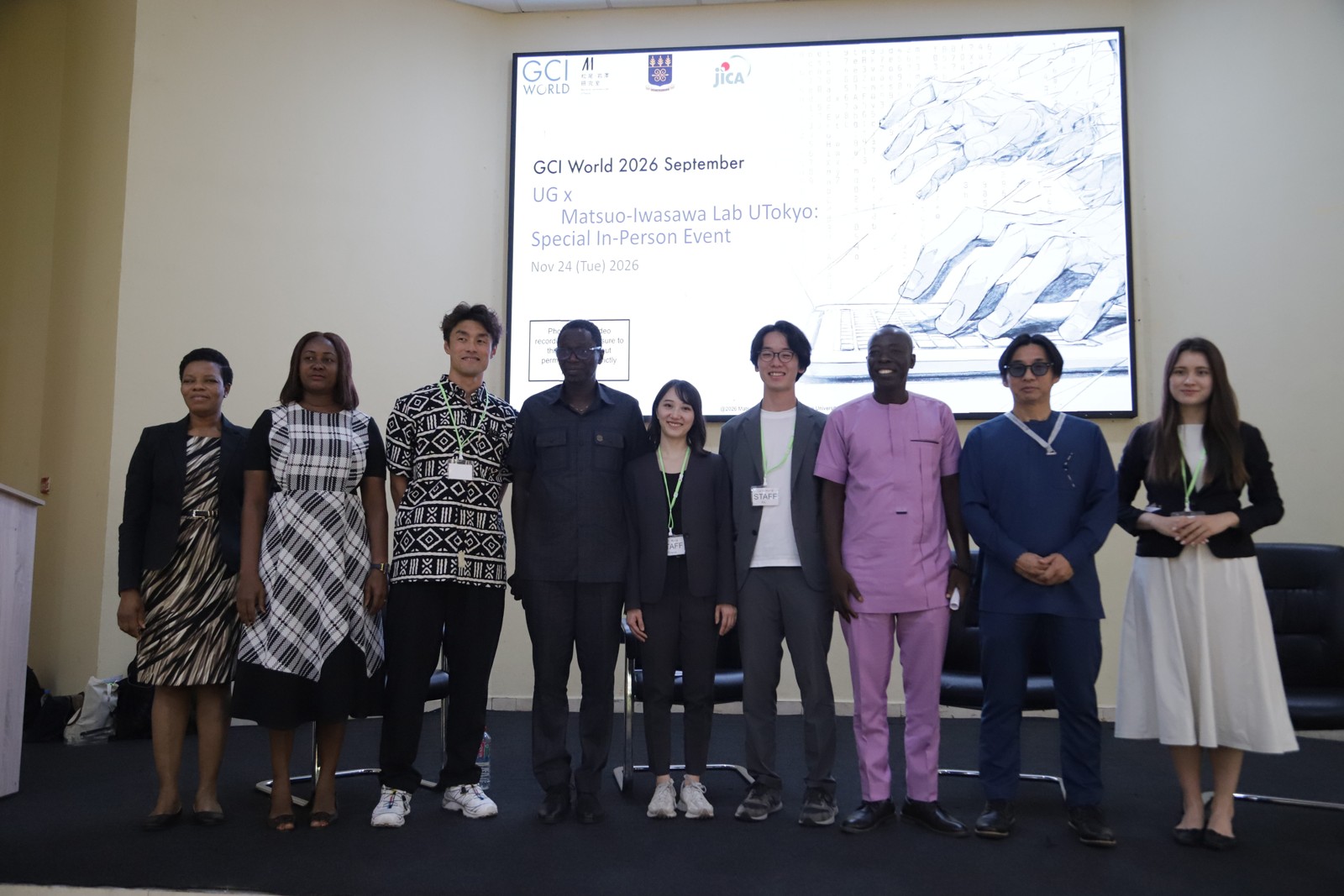
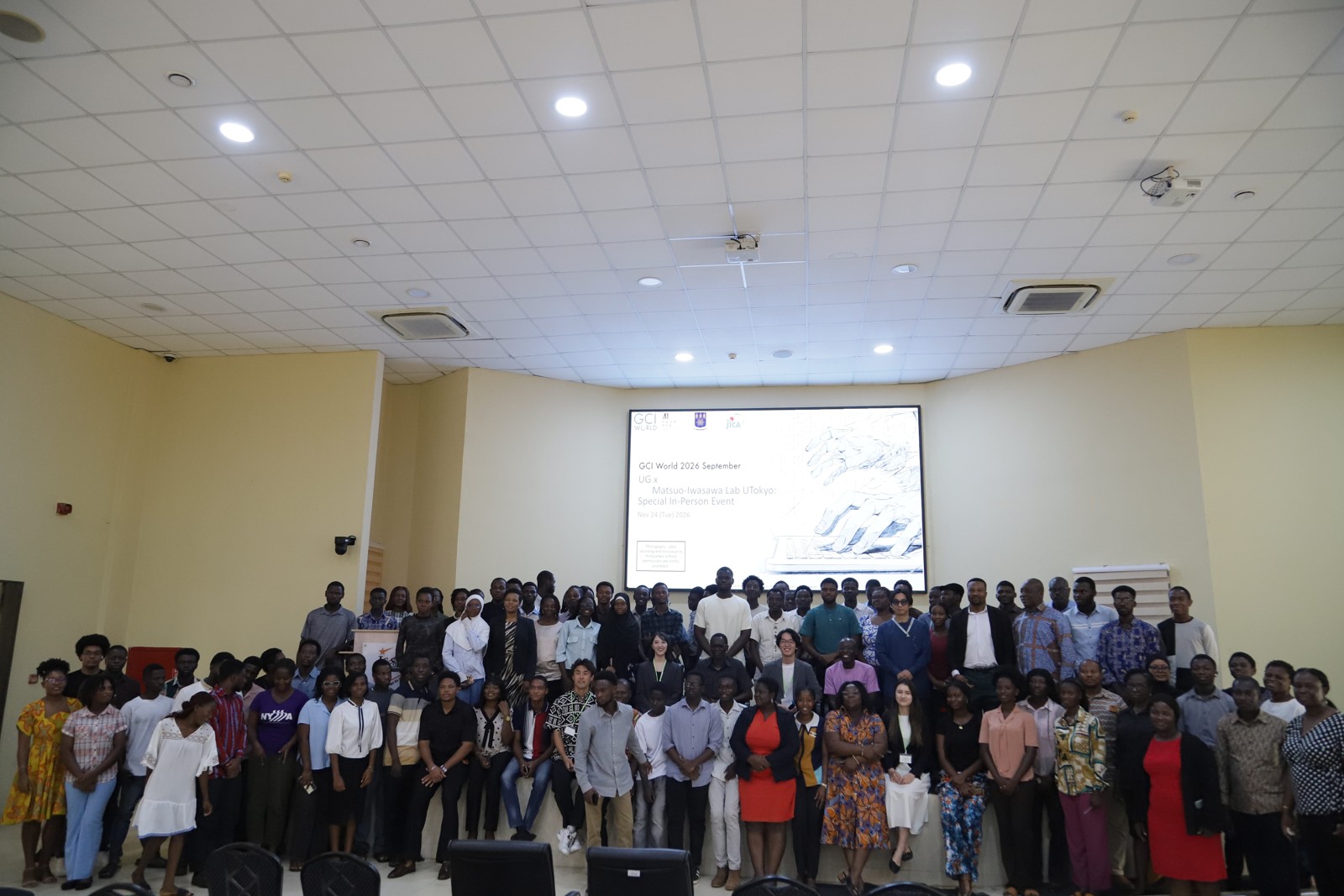
The University of Ghana (UG), in collaboration with the Matsuo-Iwasawa Laboratory of the University of Tokyo and the Japan International Cooperation Agency (JICA), hosted the GCI World Special In-Person Event on 24 November 2026 at the Institute of Statistical, Social and Economic Research (ISSER) Conference Room.
The event brought together academics, researchers, students and international partners to explore emerging opportunities in Artificial Intelligence (AI) and Data Science, with particular emphasis on responsible AI adoption, research, innovation and career development.
GCI World is a free online learning programme designed to equip participants with foundational and practical skills in data science, Python programming, machine learning and the application of data-driven solutions in business and other sectors.
The special in-person engagement provided an opportunity for participants to interact with experts, share experiences and explore the transformative potential of AI in addressing contemporary societal challenges.
Exploring the Future of Artificial Intelligence
A major highlight of the programme was a panel discussion on the impact of AI education on participants' perspectives, career aspirations and professional development.
The panel featured Akihiro Nakano, Main Lecturer of GCI World and Researcher at the Global Strategy Office; Nozomi Mitarashi, a member of the GCI World Teaching Assistant and Administrative Team; Prof. Isaac Wiafe, Professor of Information Technology and Lead Investigator of the Human-Computer Interactive Lab at UG; and Prof. Samuel Kojo Kwofie, Director of the Institute of Applied Science and Technology (IAST), UG.
Discussions centred on the rapidly evolving relationship between humans and AI, with panellists emphasising the importance of preserving human creativity, empathy, critical thinking and interpersonal relationships in an increasingly technology-driven world.
The panellists highlighted the potential of AI to enhance human capabilities, automate repetitive tasks and create opportunities for individuals to devote more time to creative thinking, research and meaningful professional engagements.
Promoting Responsible and Human-Centred AI
The discussion also explored the ethical implications of AI adoption and the need to maintain human oversight in the development and application of intelligent systems.
Panellists stressed that although AI could support decision-making and enhance productivity, responsibility for the outcomes of AI-assisted decisions remained with human users. Participants were encouraged to critically evaluate AI-generated information, verify its accuracy and exercise independent judgement before applying it.
The session further highlighted the importance of establishing appropriate boundaries for AI applications, particularly in areas where human interaction, ethical judgement and accountability remain essential.
Students and researchers were encouraged to identify specialised areas of interest, develop distinctive competencies and leverage AI to address research gaps and societal challenges. The discussion also underscored the importance of open-source research, knowledge sharing and international collaboration in advancing innovation.
During an interactive question-and-answer session, participants raised concerns about the accuracy of AI-generated information and sought guidance on responsible AI use. In response, panellists encouraged participants to regard AI as an assistant rather than a substitute for human intelligence and independent thinking.
Advancing UG's Research and Innovation Agenda
In his closing remarks, the Director of the Research and Innovation Directorate (RID), Prof. David Dodoo-Arhin, speaking on behalf of University Management, expressed appreciation to the speakers, panellists, organisers and participants for their contributions towards the success of the programme.
He commended the collaboration between RID and the Matsuo-Iwasawa Laboratory and acknowledged the GCI team's commitment to knowledge sharing and capacity development, particularly among faculty and students.
Prof. Dodoo-Arhin observed that the engagement had demonstrated the transformative potential of AI across various sectors, including healthcare and education. He emphasised that success in an increasingly technology-driven world would depend on creativity, ethical thinking and the effective application of emerging technologies.
He noted that the initiative resonated strongly with the University of Ghana's vision of becoming a world-class research-intensive university and aligned with RID's mandate to promote research, innovation, knowledge exchange and the translation of research into practical solutions.
Addressing students, Prof. Dodoo-Arhin encouraged them to view the engagement as the beginning of a continuous learning journey. He urged them to build on the knowledge acquired, remain open to emerging opportunities and explore entrepreneurship as a means of translating their skills and ideas into impactful solutions.
He further encouraged participants to build meaningful professional networks and relationships that would foster collaboration, human capital development and future innovation.
The programme concluded with a networking session, providing participants with an opportunity to exchange ideas, establish professional connections and explore potential areas of collaboration.