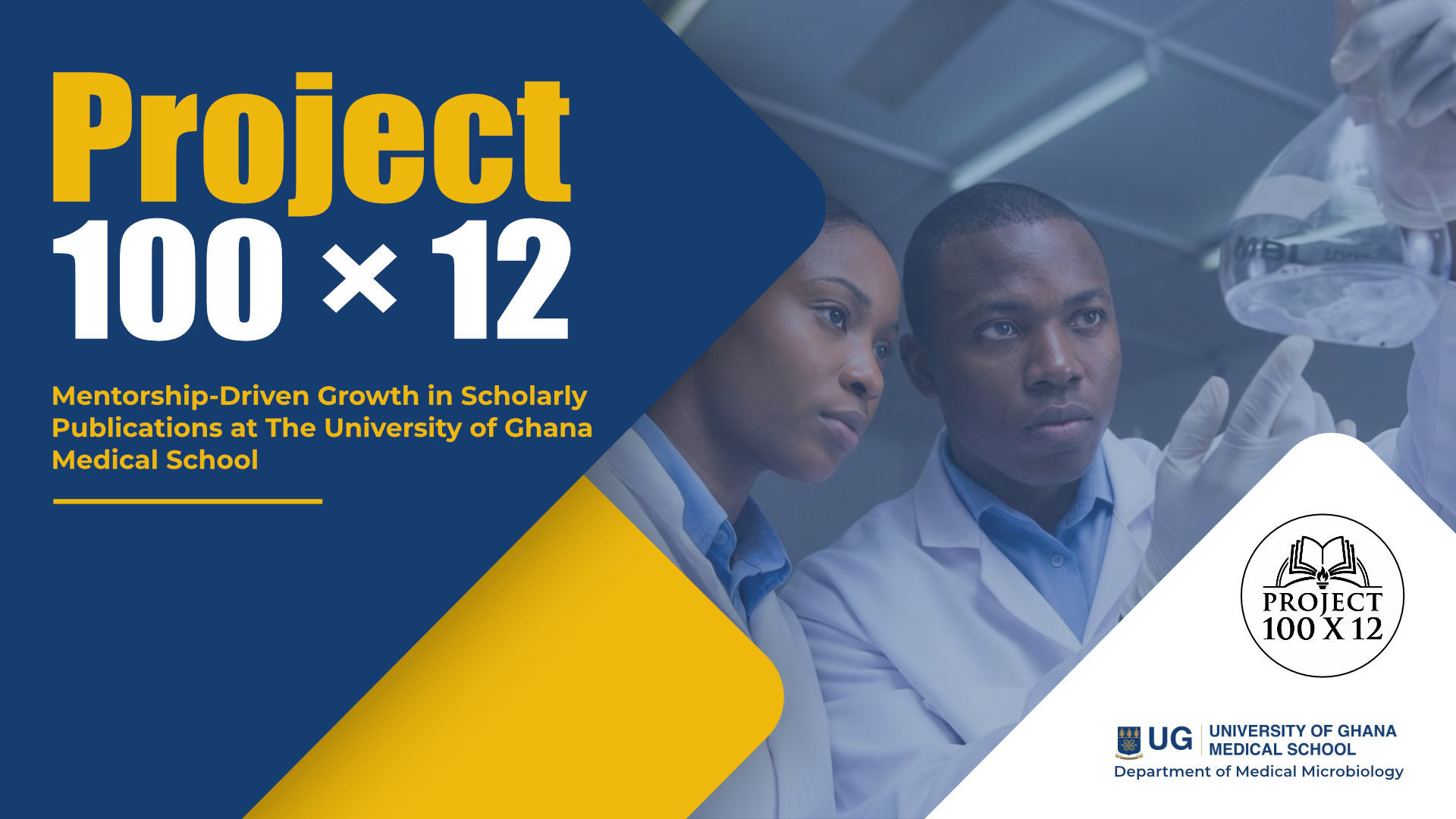
Under the leadership of Prof. Eric Sampane-Donkor, the Department of Medical Microbiology at the University of Ghana Medical School (UGMS) initiated on a mentorship and scientific writing programme captioned Project 100 by 12. The project has developed capacity of several young scholars in their formative years as researchers. The aim of the initiative is to promote a culture of scholarly excellence and reorient post-doctoral fellows towards translating research into publications. The initiative challenges early-career academics at the UGMS to produce a minimum of 100 high-impact publications within 12 months, focusing on topics such as global health, antimicrobial resistance, food safety, and emerging trends in infectious diseases.
The first iteration of the project, which commenced in June 2024, comprised PhD candidates, post-doctoral fellows, research assistants, and national service personnel. A of twelve participants who collectively achieved significant success, meeting the target of producing 100 full-length journal articles in Scopus- and PubMed-indexed journals. The project sets high standards for participants, with an impact factor benchmark of 2.0, and an emphasis on systematic reviews to avoid delays associated with ethical clearance procedures.
Among the notable outcomes of the project's trial phase and a truly remarkable achievement of nine publications by one national service person (post first-degree level) at the UGMS in journals such as International Health and Scientific Reports. According to Prof. Sampane-Donkor, who is a Professor of Bacteriology and Global Health, this milestone exceeds what is typically required for promotion to the Senior Lecturer rank at the University of Ghana and underscores the impetus that
Project 100 by 12 brings to structured mentorship and capacity development.
Prof. Sampane-Donkor reports that, with open-access waivers and favourable publisher policies, particularly from journals serving low- and middle-income countries, the team avoided paying substantial article-processing charges. In total, over £60,000 (sixty thousand pounds) was saved in fees. Several of the papers accepted, for publication benefited from fee waivers, while the National Institutes of Health (NIH) provided funding through an existing project to cover the fees for other journals.
Further, the research work of some young scholars who participated in the project has been disseminated to the wider public through the Research and Innovation Agenda Programme, a weekly live interview produced in collaboration with the Research and Innovation Directorate and the Public Affairs Directorate on Radio Univers. On 3rd December 2025, Alex Odoomand Samuel Nee-Amugi Yartey, both Graduate Research Assistants under Project 100 by 12, were interviewed about the outcomes of their respective research.
Alex Odoom discussed the findings of his research, “A Systematic Review and Meta-Analysis on Antibiotic Resistance Genes in Ghana.” The discussion highlighted the high prevalence of key antibiotic resistance genes identified in humans, animals and the environment, as well as evidence of the presence of some resistance genes across all three sectors. The conversation also touched on the need for stronger One Health surveillance and responsible antibiotic use.
Samuel Nee-Amugi Yartey reported the outcomes of his research, “Antibiotic Impact on Human Microecology in Low- and Middle-Income Countries (LMICs): A Systematic Age-Stratified Review of Gut and Respiratory Microbiome and Resistome.” The interview highlighted the effects of antibiotic use on the gut and respiratory microbiome, including reduced microbial diversity and increased antibiotic resistance genes. The dissemination revealed that children experience more severe and longer-lasting effects of antibiotic resistance, underscoring the need for stronger antibiotic stewardship in children.
As the project looks ahead to building networks of early-career academics that transcend publication records, Prof. Sampane-Donkor is preparing to launch additional phases, increasing the publication goal from 100 to 120 papers and raising the minimum impact factor threshold from 2.0 to 2.5. So far, the success of the first phase has generated keen interest, with multiple proposals already received from early-career scientists eager to participate.
Project 100 by 12 has received international peer recognition, including in a University of Minnesota news report. The initiative stands as proof of concept for how structured mentorship, with a focused target, can yield significant gains in research output. This model has advanced not only the individual academic careers of participants but also bodes well for institutional rankings. The gains of this initiative underscore the benefits of high standards in research and align with UG’s strategic goal of impactful research.
The success of Project 100 x 12 underscores the University of Ghana’s strategic plan of transformative student experience and impactful research. To sustain this laudable programme and scale it up, additional funding is required. The initiative has motivated academics to achieve valuable career mileage and fulfil promotion requirements in record time. To this end, partnerships and collaborations are invited to expand the scope of the project.
Based on the success of the project, Prof. Sampane-Donkor recommends the revival of the Legon Readers’ Series, with a strong emphasis on systematic reviews. The Readers’ Series, in its brief existence, generated several publications which continue to educate and inspire collective scientific writing among faculty and students.