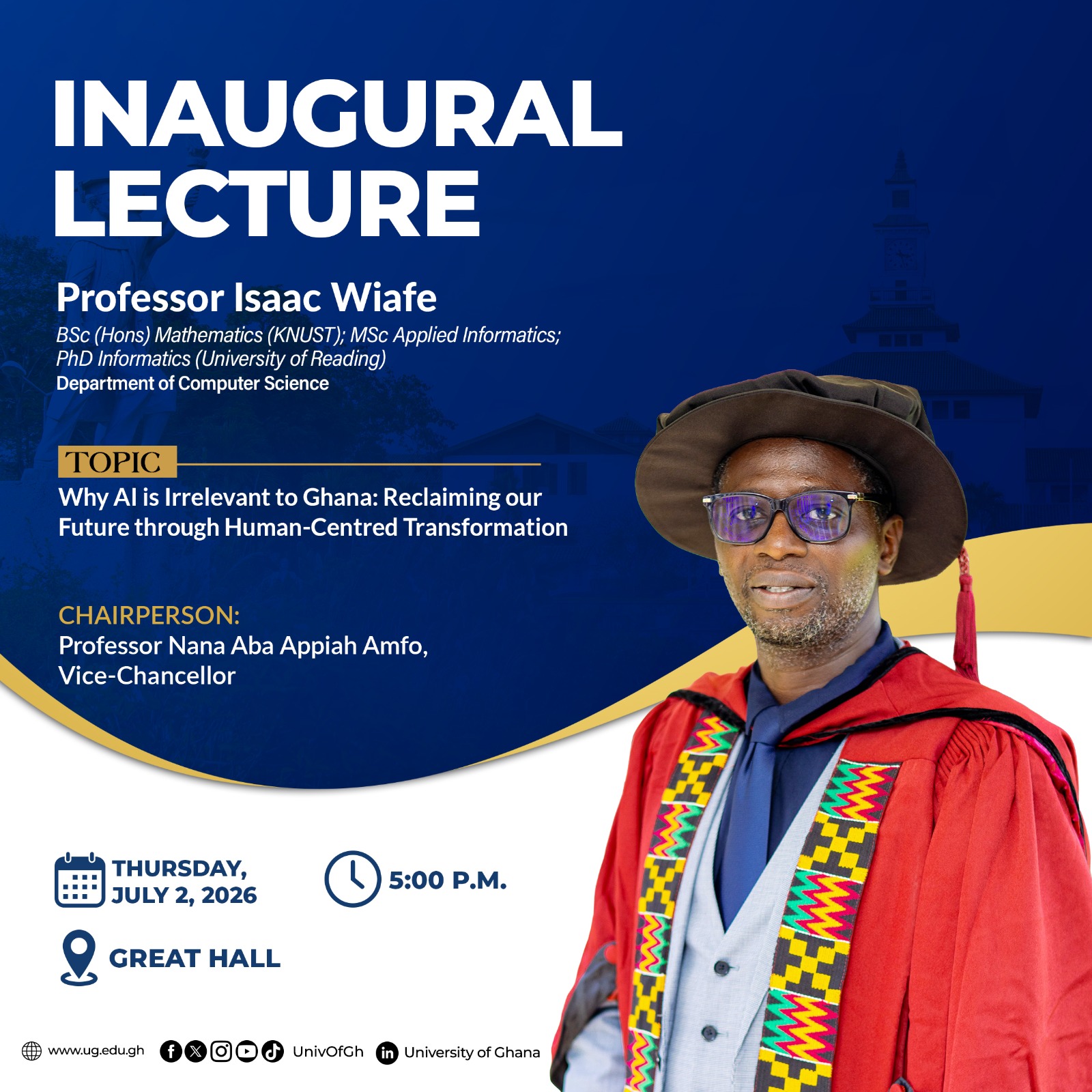
Profile
Professor Isaac Wiafe is a Professor of Information Technology at the University of Ghana whose research focuses on Human-Computer Interaction, Artificial Intelligence, Persuasive Technology, Extended Reality and Digital Inclusion. As head of the Human-Computer Interaction Lab (HCI-Lab), he has advanced the design of intelligent technologies that influence human behaviour to address challenges in health, education, transportation and digital transformation. His pioneering work includes the development of the 3D-RAB Model and the U-FADE framework, which have become important contributions to persuasive technology research. He has also led innovative projects in African language technologies, speech recognition, inclusive AI and conversational systems, significantly expanding access to digital technologies for underserved communities.
Beyond his research, Professor Wiafe has made outstanding contributions to teaching, mentorship and technology-driven innovation. He has supervised numerous postgraduate students, secured competitive international funding from organisations such as Google, UNICEF and IDRC, and led major projects that have produced Ghana's largest publicly available speech and text datasets for local languages. His extensive scholarly publications, international collaborations and consultancy work have influenced both academia and industry, while his commitment to human-centred technology continues to drive digital inclusion and the responsible application of artificial intelligence in Ghana and beyond.
Why AI is Irrelevant to Ghana: Reclaiming our Future through Human-Centred Transformation
Artificial Intelligence (AI) is arguably the most influential technology of the twenty-first century. Governments, multinational corporations and international development agencies increasingly portray AI as a transformative force capable of addressing challenges in healthcare, education, agriculture, governance, transportation, and economic development. Yet amid the growing enthusiasm surrounding AI, a critical question remains unexplored: Is AI truly relevant to Ghana in its current form, and what conditions are necessary for it to contribute meaningfully to national development?
This lecture argues that, in its current form and trajectory, AI offers limited value to Ghana’s development aspirations, not because the technology lacks potential, but because the dominant AI discourse is shaped by external priorities, foreign datasets, imported assumptions and technological solutions that are often disconnected from Ghana’s socio-economic realities. Consequently, the lecture challenges the prevailing narrative that presents AI adoption as a prerequisite for development and instead advocates a human-centred approach to digital transformation that prioritises local needs, cultural contexts, indigenous knowledge systems and community empowerment.
Drawing on emerging evidence from our studies on technology adoption, digital inclusion and AI awareness in Ghana, the lecture demonstrates that the relevance of AI is constrained by more fundamental developmental challenges. Limited digital infrastructure, education systems that have not adequately adapted to emerging trends, weak data ecosystems and significant digital literacy gaps continue to hinder the effective development, deployment and use of advanced technologies. For many communities, particularly in rural and underserved areas, the pressing need is not access to sophisticated AI systems, but access to reliable digital services, affordable connectivity and technologies that address everyday social and economic challenges.
The lecture further argues that the current AI ecosystem risks creating a new form of digital dependency at scale. It may contribute to cultural homogenisation, marginalise indigenous knowledge, reinforce existing inequalities and weaken local innovation ecosystems. These concerns raise important questions about technological sovereignty, data ownership, algorithmic governance and Ghana’s ability to shape its own digital future.
Rather than rejecting AI, this lecture calls for a fundamental reframing of Ghana’s technological agenda: from an AI-first approach to a human-first approach. Such a shift requires moving beyond the question of how to teach people to use AI and instead asking whether the AI we adopt understands our languages, reflects our cultures, addresses our societal challenges and advances our development goals. The central question, therefore, is not whether Ghana should adopt AI, but whether Ghana can build transformational AI models that places human development, cultural preservation, technological sovereignty and societal well-being at its core. In this vision, AI is relevant only to the extent that it advances these objectives. We must not seek to create an AI-powered Ghana, but to build a Ghana-powered future in which technology is shaped by the needs, values and aspirations of its people.