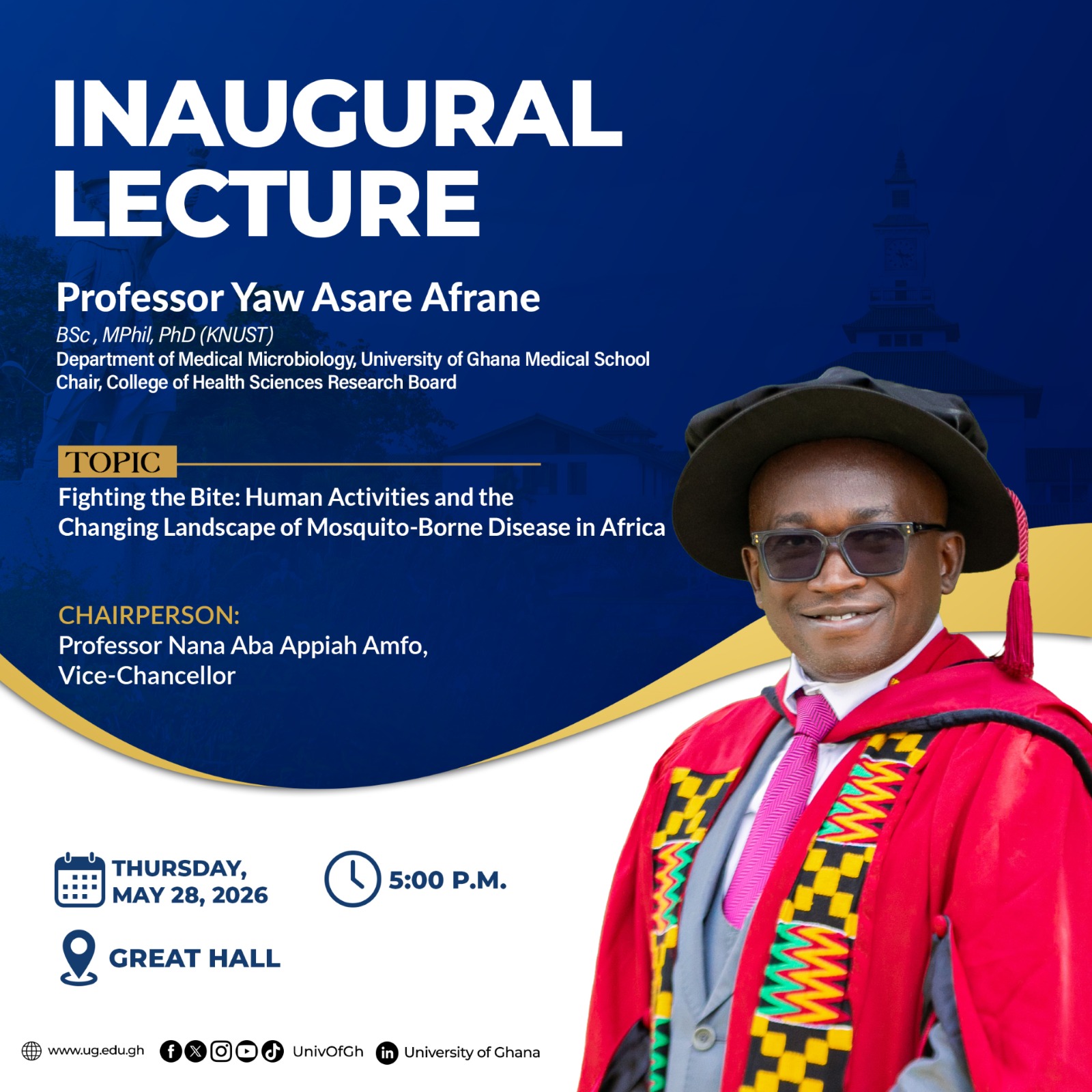
PROFILE
Professor Yaw Asare Afrane is a Professor of Medical Entomology and Parasitology at the University of Ghana Medical School whose research focuses on mosquito ecology, malaria transmission and vector-borne diseases. His work has significantly advanced the understanding of insecticide resistance, mosquito behaviour and disease epidemiology, providing critical evidence that has shaped malaria control policies in Ghana and across Africa. Throughout his academic career, he has combined research, teaching and international collaboration to strengthen public health interventions, while mentoring the next generation of African scientists in medical entomology and epidemiology.
In addition to his research achievements, Professor Afrane has demonstrated outstanding leadership in research management, postgraduate education and international scientific collaboration. He has secured over US$17 million in competitive research funding, authored more than 130 peer-reviewed publications, and led major capacity-building programmes that have trained dozens of African researchers. As Chair of the College of Health Sciences Research Board and an advisor to national and international malaria control initiatives, his work continues to influence vector control strategies, strengthen research capacity, and improve public health policy across the continent.
Abstract:
Mosquitoes are widely considered the deadliest animals on this planet earth; responsible for more human deaths than any other creature, far surpassing that of lions, snakes, sharks or even humans themselves. Throughout history, they have remained a major public health threat due to their role as transmitters of disease-causing pathogens, including parasites responsible for malaria and lymphatic filariasis, viruses such as yellow fever, dengue, chikungunya and Zika, as well as bacteria like Rickettsia felis. Collectively, these mosquito-borne diseases claim more than one million lives each year. Only female mosquitoes bite, as they require blood meals for egg development. During feeding on humans or animals, they can efficiently transmit a wide range of pathogens. In Ghana, malaria remains the most prevalent mosquito-borne disease. Lymphatic filariasis is also endemic in certain districts, while yellow fever outbreaks occur sporadically. In addition, dengue and chikungunya are emerging mosquito-borne diseases of growing public health concern in Ghana.
Mosquitoes breed in small collections of stagnant water such as rainwater puddles, discarded tires and containers and blocked drains, allowing them to thrive in densely populated urban areas. They also breed in natural habitats like tree holes, which are often difficult to identify and control.
While some mosquito species mainly feed on animals, others prefer humans and are key transmitters of human diseases. Many species, however, feed on both humans and animals, increasing the risk of zoonotic disease transmission, including yellow fever, dengue and simian malaria. Research by my group at the University of Ghana has shown that some mosquitoes feed on humans as well as animals such as dogs, cattle and goats simultaneously within the same environment, potentially enabling pathogen exchange between animals and humans.
After feeding on humans, mosquitoes may rest indoors or move outdoors to rest around homes while digesting their blood meal. They often seek shelter in hedges surrounding houses or in other protected areas within the household environment. Once digestion is complete, female mosquitoes search for nearby sites to lay their eggs, usually not far from their resting locations. Therefore, human activities around homes can inadvertently create suitable breeding habitats and resting spots that support mosquito reproduction.
Human activities such as deforestation, swamp reclamation, surface mining and agricultural expansion significantly contribute to mosquito breeding and spread. The conversion of forests and wetlands into farmland exposes soil to sunlight, increases local temperatures and creates favourable breeding conditions for disease-transmitting mosquitoes, particularly Anopheles gambiae, a major vector of malaria and lymphatic filariasis in Africa. My previous research in the western Kenyan highlands demonstrated how such land use changes can lead to the emergence of new mosquito species involved in malaria transmission.
The pursuit of food security and income generation in cities such as Accra, Kumasi and Takoradi has led some urban farmers to utilise idle inner-city lands for vegetable cultivation. Many of these areas have high water tables, such that digging only a few meters below the surface allows groundwater to seep out for irrigation purposes. However, these informal irrigation systems can create suitable breeding habitats for mosquitoes, thereby facilitating the transmission of disease-causing pathogens within and around urban communities. My research findings indicate that malaria prevalence is higher in neighbourhoods located near these irrigated vegetable farming sites.
Several mosquito control interventions have been implemented by the Ghana Health Service through the National Malaria Elimination Programme and the Disease Control Unit to reduce mosquito nuisance and limit the transmission of mosquito-borne diseases. These interventions include the distribution of insecticide-treated bed nets to communities, Indoor Residual Spraying (IRS), which involves applying insecticides to the walls of human dwellings and larval source management, which targets and eliminates immature mosquitoes in their breeding habitats. On the personal level, many residents also adopt personal mosquito control measures, such as the use of aerosol insecticide sprays and mosquito coils within their homes. Others install screens on windows and doors to prevent mosquitoes from entering indoor spaces. These measures provide residents with greater comfort and protection, particularly during the evening and nighttime hours before sleep.
These interventions have been largely effective in many communities in Ghana; however, mosquito populations have increasingly adapted to them. In particular, resistance to several commonly used insecticides has become widespread, reducing the effectiveness of control efforts. After Indoor Residual Spraying, for example, mosquitoes may be temporarily knocked down, only to recover shortly afterward and resume seeking human blood meals.
Unfortunately, most mosquito control strategies in Ghana and across much of Africa remain heavily reliant on insecticide-based and indoor-focused approaches. Moreover, the same classes of insecticides used in public health are also widely applied in agriculture for pest control, increasing the overall exposure of mosquitoes to these chemicals and further contributing to the development of resistance.
Mosquitoes have also developed behavioural adaptations that help them avoid insecticide exposure. In areas with widespread use of bed nets, our studies show some mosquito populations now tend to bite earlier in the evening, before people go to bed and come under net protection. Similarly, where Indoor Residual Spraying is implemented, our studies indicate that mosquitoes may shift their biting activity to outdoors, feeding on humans before they enter their homes. When opportunities to bite humans are reduced, they may also feed on animals that are not protected by control measures, which can support their survival and population growth. In addition, routine human outdoor activities such as trading, recreation and social gatherings provide further opportunities for mosquito feeding, as people are often unprotected during these periods.
In conclusion, human activities have significantly contributed to the proliferation and adaptation of mosquitoes in Africa. Land use changes and other environmental modifications have created favourable conditions for mosquito breeding and expansion into human communities. In addition, practices such as widespread insecticide use and environmental pollution, including petroleum spills, have further driven mosquito adaptation, enabling them to thrive in close proximity to humans and continue transmitting disease-causing pathogens. There is a need to explore and adopt alternative, sustainable strategies to address these challenges in order to prevent future public health crises, including potential pandemics.