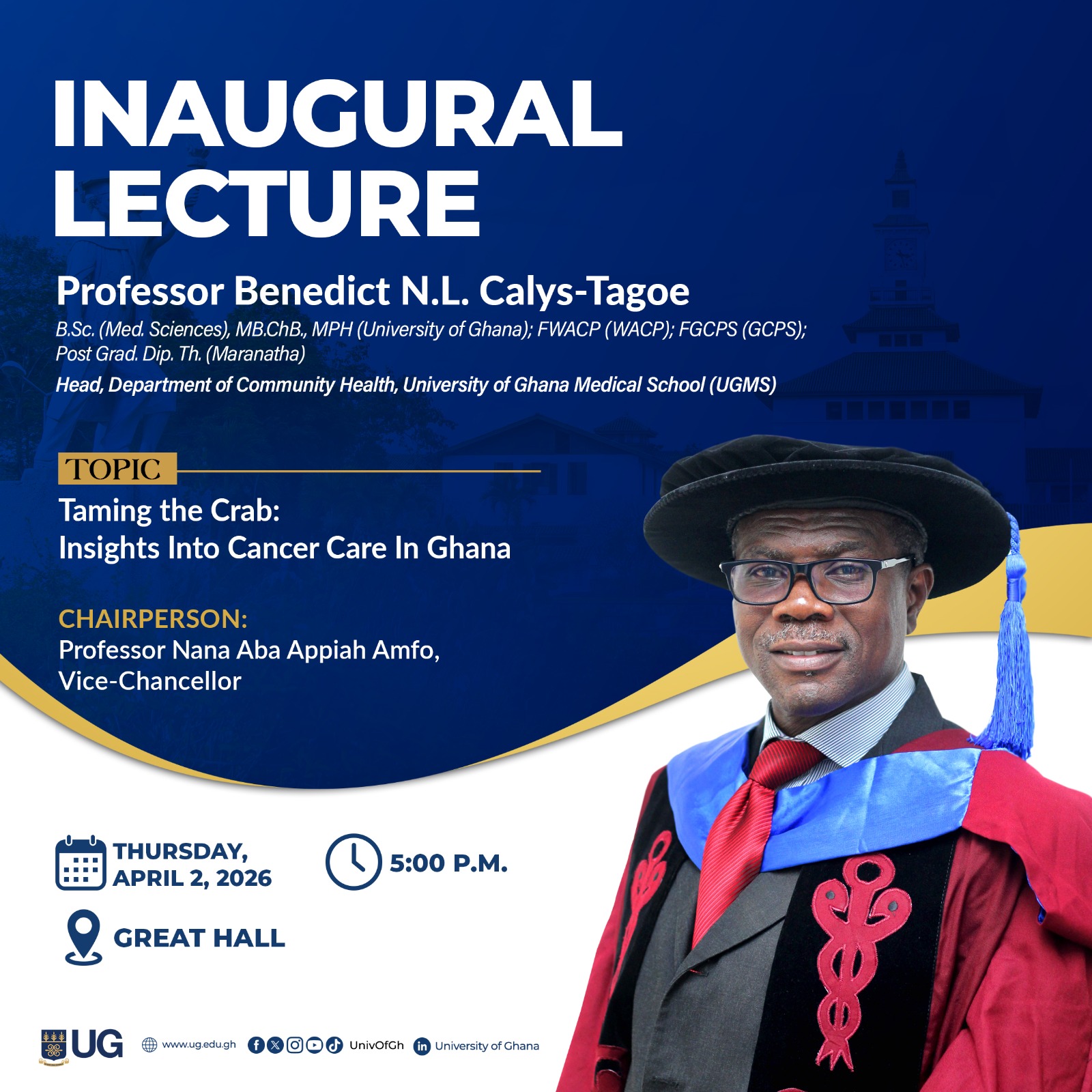
ROFILE: PROFESSOR BENEDICT NII LARYEA CALYS-TAGOE
Benedict Nii Laryea Calys-Tagoe is a Professor of Community Health with expertise in epidemiology, disease control and surveillance. He is a distinguished physician, educator and public health leader whose career spans clinical practice, academia, administration, international research and faith-based service. His works reflect a deep commitment to advancing health equity, building institutional capacity and mentoring future generations of health professionals.
EDUCATION AND PROFESSIONAL QUALIFICATIONS
Professor Calys-Tagoe attended the Presbyterian Boys’ Secondary School (PRESEC), Legon where he obtained his GCE ‘O’ and ‘A’ level certificates.
He earned his BSc (Medical Science) and MBChB from the University of Ghana Medical School (UGMS) and a Master of Public Health from the University of Ghana School of Public Health. He is a Fellow of both the West African College of Physicians (WACP) and the Ghana College of Physicians and Surgeons (GCPS).
His specialised training includes a Certificate of Expertise in Cancer Registration Methods from the African Cancer Registry Network, Rapid Response Team Management (CDC, 2020), and a Post-Doctoral Fellowship in Global Health Research at the University of Michigan School of Public Health. In 2024, he earned a Postgraduate Diploma in Theology from the Maranatha University College, reflecting his commitment to integrating faith and service into his professional life.
AREAS OF EXPERTISE AND RESEARCH FOCUS
Professor Calys-Tagoe is an accomplished Epidemiologist and Public Health Practitioner with over 23 years of clinical practice and 19 years of public health practice and research.
Professor Calys-Tagoe’s research centers largely on the epidemiology of non-communicable disease, with particular interest in small-scale mining, cancers and neurological conditions such as Parkinson’s disease, dementia and stroke. His works include genomic studies of these conditions within African populations, contributing to global efforts to understand disease patterns in underrepresented communities.
His foundational interest in occupational epidemiology stems from his early work on artisanal and small-scale gold mining. As a Principal Investigator in the “Integrated Assessment of Artisanal and Small-Scale Gold Mining” project, he led the human health component of a multidisciplinary collaboration involving researchers from Ghanaian institutions and colleagues from the University of Michigan. This work examined the health, environmental, and policy implications of artisanal and small-scale mining practices in Ghana.
Professor Calys-Tagoe has been involved in several high-impact research projects in the area of Stroke. These include the Stroke Investigative Research and Educational Network (SIREN) project which till date is the largest study of stroke among Blacks. He has also been involved in a project that studied Ethical, Legal and Social Implications (ELSI) of Stroke genomic research. Other neurological research projects he is involved in are the ‘Transforming Parkinson’s Care in Africa (TraPCAf), the Recruitment and Retention of Alzheimer's Disease Diversity Genetic Cohorts in the Alzheimer’s Disease Sequencing Project (READD–ADSP) and the Origins of Alzheimer’s Disease In African Americans (a study that seeks to unravel the racial and/or ethnic disparities in Alzheimer’s Disease genetics and epidemiology).
He is very passionate and deeply involved in cancer research - focusing on breast and cervical cancers and the development of cancer registries in resource-limited settings. His research aims to improve early detection, rational control, treatment access and public awareness of cancers.
Professor Calys-Tagoe serves as a reviewer for several peer-reviewed journals and has authored/co-authored several (over 80) peer-reviewed articles which have been published in very high impact journals like The Lancet.
TAMING THE CRAB: INSIGHTS INTO CANCER CARE IN GHANA
Abstract
Background
The word cancer literally means crab.
Cancer is a significant public health concern both globally and locally. Globally, over 20 million cases and 9.7 million deaths are reported annually. It is the second leading cause of death worldwide, accounting for nearly one in six deaths. Low-and-middle-income countries shoulder most of the cancer burden. Out of nearly 10 million cancer-related deaths worldwide, 70% were in low-and-middle-income countries. The disparity is even more striking in the case of cervical cancer where 90% of new cases and deaths from this preventable cancer occur in low- and middle-income countries.
In Ghana, approximately 27,385 new cases and 17,944 deaths are reported annually. Cancer incidence in sub-Saharan Africa is projected to increase by more than 92% between 2020 and 2040. It has been suggested that cancer cases might surpass malaria, TB and HIV combined by 2030, especially considering the rising cancer burden in low- and medium-HDI countries.
Contrary to what people think, cancer is not a homogenous disease. It is a complex and heterogeneous group of diseases characterised by uncontrolled cell growth and spread. There are over 100 different types of cancer, each with distinct biological characteristics, behaviors and responses to treatment. This heterogeneity makes cancer diagnosis, treatment and research challenging, but also drives the development of personalised medicine approaches.
Cancer Incidence and Mortality Rates in Ghana:
The most common cancers in Ghana are breast and cervical cancers (for females), prostate and liver cancers (for males) and Retinoblastomas and lymphomas (for children).
- Breast Cancer: The leading cause of cancer incidence and mortality among women, with over 5,000 new cases and approximately 2,400 deaths annually.
- Prostate Cancer: The most common cancer among men
- Liver Cancer: The leading cause of cancer death in Ghana, prevalent in both genders.
- Cervical Cancer: The second most common cancer in females, with high mortality rates.
Cancer control
In public health teaching, cancer control usually subscribes to the rule of thirds:
- About a third are preventable (through vaccinations, lifestyle modifications and reducing exposure to risk factors)
- About a third are potentially curable if detected early (through screening and prompt treatment)
- About a third would require palliation (focus on symptom control, pain relief, psychosocial and spiritual support and overall improvement in the quality of life)
This is not a law of statistics, but a planning and advocacy tool used by WHO, UICC and cancer control programmes. It is conceptually correct but not exact and therefore should not be interpreted rigidly.
Challenges to cancer control
There are a number of barriers to effective cancer control in Ghana. The key ones are:
- Limited availability of cancer data (lack of cancer registries) – e.g. we have no reliable data on the proportion of women with cervical disease (precancer or invasive) who have received treatment. The WHO target is 90%
- Limited access to cancer screening and treatment services (e.g. only 3% of women in Ghana have been screened with a high-performance test like HPV-DNA by age 35. The WHO target is 70% by 2030)
- Financial toxicity (high cost of cancer care) – most cancers are not covered by NHIS and for those covered, the tariffs being paid are not realistic, hence providers are reluctant to offer services
- Late presentation and diagnosis of cancer cases – more than half of all cancer patients present late due to a myriad of factors.
Way forward
- Establishment of population-based cancer registries with clearly defined sustainable funding.
- Decentralising cancer screening and treatment services
- Implementation of free PHC
- Improve/expand funding sources of NHIS so they can pay realistic tariffs to service providers to encourage service delivery
- Strengthening of community-based awareness campaigns and early detection programs
Conclusion
- Most of the common cancers in Ghana are either preventable (cervical and liver) or curable if detected early (breast, cervical and prostate) and this presents us with a window of opportunity. We can significantly decrease the morbidity and mortality from these cancers by:
- Improving and sustaining HPV vaccination (we have so far achieved 84% of the 90% target for elimination of cervical cancer by 2030)
- Introducing HBV at birth (to reduce incidence of liver cancer)
- Establishing cancer registries to track cancer patients across the entire continuum of cancer care
The knowledge and skills required to achieve this already exist, what remains is the political will and commitment.