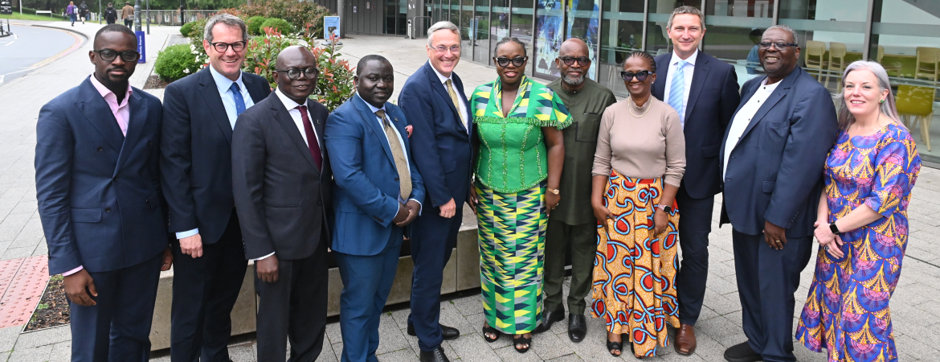
Professor Nana Aba Appiah Amfo delivered a lecture at the University of Warwick’s annual Distinguished Africa Lecture series, which took place on Thursday, 11th June 2026, in the United Kingdom. The lecture forms part of Warwick’s ongoing commitment to engaging with leading African scholars and deepening partnerships across the continent.
The event began with Warwick’s annual Africa Panel Discussion, hosted by Professor Michael Scott, Pro-Vice-Chancellor (International), which set the context for the lecture by bringing together academic and policy perspectives on equitable partnerships between universities in the Global North and South.
The discussion explored how international collaborations can move beyond transactional approaches towards models grounded in shared value, mutual respect, and long‑term impact, reflecting many of the themes that continue to shape Warwick’s engagement across the region.
Panellists leading the discussion were:
- Professor Cristina D'Alessandro, Responsible for Statistical Cooperation with sub-Saharan Africa, French National Institute for Statistics and Economic Studies (INSEE), Paris, and Professor at Sciences-Po, Paris.
- Professor Paramjit Gill, Co-Lead, Africa-Europe CoRE on Multimorbidity, Warwick Medical School, University of Warwick
- Professor Ambreena Manji, Dean of International for Africa, Cardiff University
- Professor Collins Badu Agyemang, Director of Pan African Doctoral Academy, University of Ghana
- Professor Christine Ennew OBE, Vice-Chair Board of Governors, Harper Adams University, and former Provost University of Warwick
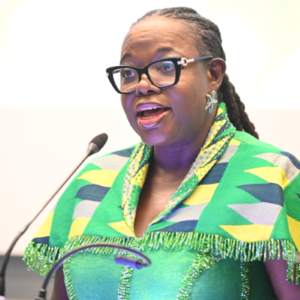
The lecture, titled “Whose Language Counts? African Voices, Knowledge Systems and the Future of AI,” explored the role of African languages and knowledge systems in shaping the development and application of artificial intelligence.
Professor Amfo reflected on the importance of inclusive knowledge production and the need to ensure that African perspectives are embedded in global technological futures. She also emphasised that language is central not only to communication, but to how societies organise meaning, preserve knowledge, and represent lived realities in digital systems.
Setting out this challenge, Professor Amfo said:
The challenge before us is not whether Africa will participate in AI. Africa is already participating.
The question is: will Africa participate merely as a consumer of externally developed systems, or will Africa help shape the languages, values, assumptions, and knowledge structures embedded within those systems?
Highlighting the implications of linguistic exclusion, she added:
When a language is absent from the digital corpus, it is not merely a translation problem. It is a visibility problem. It is a knowledge problem. And ultimately, it becomes a question of justice.
Attended by more than 280 participants in person and online, the Distinguished Africa Lecture brought together staff, students, and external partners, creating space for discussion on shared challenges and opportunities in higher education, research, and innovation.
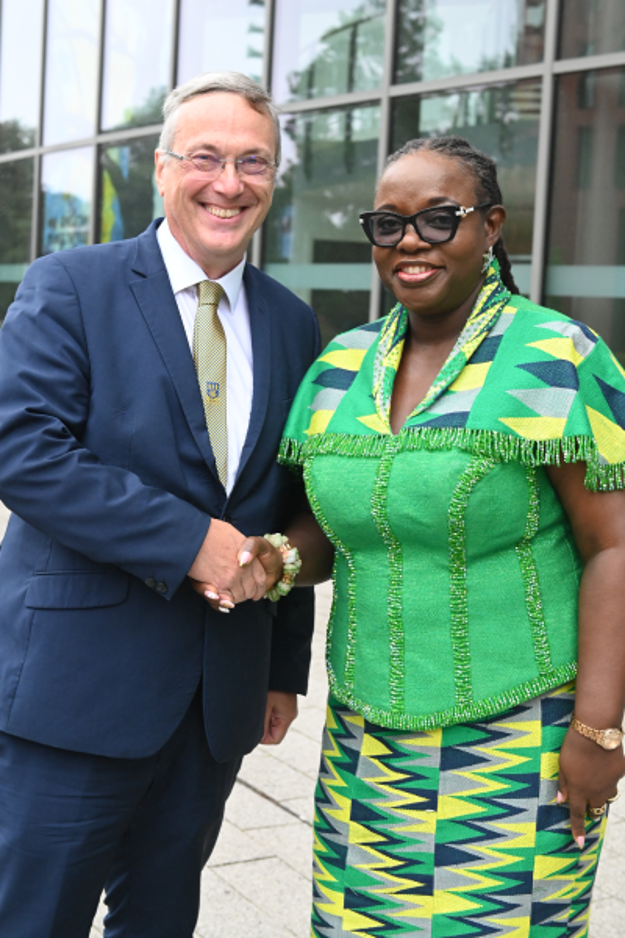
The lecture was hosted by Warwick’s Vice‑Chancellor and President, Professor Stuart Croft, who said:
It was a pleasure to welcome Professor Amfo to Warwick for this year’s Distinguished Africa Lecture.
Her contribution highlights the importance of diverse perspectives in shaping the future of research and innovation. Our growing relationship with the University of Ghana reflects a shared commitment to collaboration that is thoughtful, mutually beneficial, and grounded in areas of common interest.
Professor Amfo’s visit marks an important step in the developing relationship between Warwick and the University of Ghana, which is emerging as a significant strategic partnership within Warwick’s wider Africa portfolio.
This collaboration builds on strong existing links across multiple Warwick departments and professional services, alongside close engagement through international networks including ARUA, the Guild, and the Europe–Africa Clusters of Research Excellence.
The relationship has been further strengthened by a visit to Ghana in June 2024 by Professor Dan Branch, Professor Franklyn Lisk, and Sally Smith, followed by the signing of an institution-wide Memorandum of Understanding in 2025. Together, these milestones have laid the foundations for a more coordinated and ambitious programme of collaboration.
Professor Dan Branch, Deputy Pro‑Vice‑Chancellor (Africa), said:
The University of Ghana is an important partner for Warwick, with strong alignment across several academic and strategic priorities.
Of particular significance is our co-leadership with the University of Ghana (and the University of Pretoria) of the Africa-Europe Cluster of Research Excellence on Multimorbidity. Building on existing collaborations and the recent Memorandum of Understanding, we are now working to develop a more structured programme of engagement.
This includes new opportunities for joint research, academic exchange, and capacity building, which will be taken forward over the coming year.
Looking ahead, Warwick and the University of Ghana are planning a series of joint online workshops in priority areas identified through recent engagement, including Theatre and Performance Studies, Ageing, Languages, Manufacturing, academic development, and student mobility. Internal coordination is already underway, with mapping of existing collaborations completed to support the next phase of activity.
Warwick’s partnership with the University of Ghana reflects a shared commitment to developing collaborative approaches to research and education that are mutually beneficial and globally relevant. This is reflected in joint initiatives such as the Africa–Europe Cluster of Research Excellence on Multimorbidity. Shortly following the lecture, the cluster will convene at the University of Glasgow for the 2026 Second Africa–Europe Clusters of Research Excellence (CoRE) Conference. With Ghana’s strong academic reputation and the UK’s strategic engagement in the region, the relationship is well-positioned to develop into a comprehensive, institution-wide partnership spanning research, education, mobility, and broader strategic engagement across Africa.
By bringing leading voices such as Professor Amfo to campus, the Distinguished Africa Lecture continues to play an important role in strengthening these connections, supporting meaningful exchange, and reinforcing Warwick’s commitment to sustained, equitable partnerships across the continent.