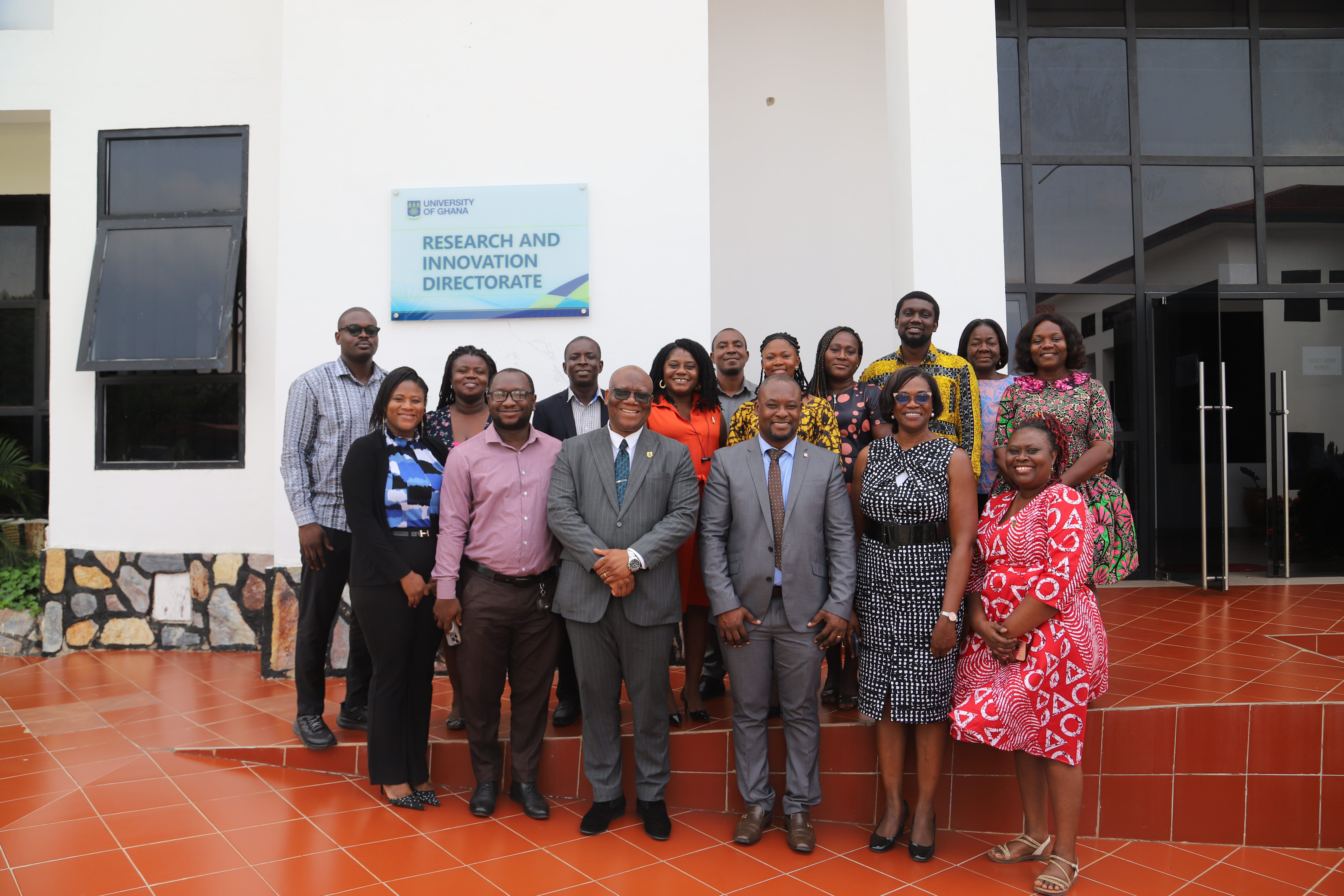
The Research and Innovation Directorate (RID) hosted a delegation from the Office of Grants and Research (OGR) of the Kwame Nkrumah University of Science and Technology (KNUST) on Tuesday, July 21, 2026. The visit formed part of efforts to gain insights into UG's research management journey and identify opportunities for institutional collaboration.
The KNUST delegation was led by the Director of the Office of Grants and Research, Prof. Jerry John Honya, accompanied by a team of research managers and an accountant.
Welcoming the delegation, Prof. David Dodoo-Arhin, Director of Research and Innovation, noted that although he had interacted with Prof. Honya at various research fora over the years, there had not been an opportunity for formal engagement between the two institutions. He cited KNUST's recent Horizon award and a Wellcome Trust grant, in which the University of Ghana is a sub-awardee, as encouraging developments that provide a strong foundation for strengthening collaboration. Also present at the meeting were Prof. Nancy Quashie, Deputy Director of RID, and Research Development Officers of the Directorate.
Prof. Honya explained that KNUST is undertaking a restructuring of aspects of its research administration following the introduction of a new legislative framework aimed at realigning research to achieve greater national impact. As part of this process, the delegation sought to learn from the University of Ghana's experience and adopt best practices in research management. He stressed the importance of collaboration among national institutions to maximise research impact and advance Ghana's development agenda.
During the meeting, Prof. Dodoo-Arhin presented an overview of the University's research and innovation ecosystem, outlining UG's vision and mission, the transition to the collegiate system, and the establishment of the Office of Research, Innovation and Development in 2010. He noted that positioning research leadership at the highest level of University management was a strategic step towards achieving UG's ambition of becoming a research-intensive university. He also highlighted several flagship research and innovation initiatives through which the University has expanded partnerships beyond academia to industry and other stakeholders.
The delegation sought guidance on how UG has built the capacity of its researchers and the strategies employed to sustain their motivation. In response, Prof. Dodoo-Arhin highlighted several institutional and international initiatives that have strengthened research capacity, including participation in the Cambridge Africa Research Excellence (CARE) programme, the Erasmus+ partnership with the University of Sheffield, and active staff membership in professional research management organisations such as the National Council of University Research Administrators (NCURA) and the Southern African Research and Innovation Management Association (SARIMA).
Discussions also highlighted a common challenge faced by both institutions: bridging the gap between available funding opportunities and researchers' responses to competitive grant calls. Participants agreed that closer collaboration could improve proposal development and submission rates, thereby increasing the likelihood of securing external research funding.
The meeting further explored the decentralisation of grants management at the University of Ghana and how the transition has influenced RID's mandate to safeguard the University's research interests and reputation. The two institutions also exchanged experiences on grant data management, monitoring and analysis, as well as the role of specialised accounting systems in ensuring compliance with international funding requirements.
A key outcome of the discussions was the shared recognition that Ghanaian universities must embrace a collaborative approach to research and innovation in the national interest. Both institutions reaffirmed their commitment to strengthening institutional partnerships, promoting knowledge exchange, and pursuing collaborative initiatives that will enhance research excellence and national development.
The meeting concluded with a mutual commitment to sustained dialogue and future collaboration, with both institutions expressing optimism about the opportunities that lie ahead.