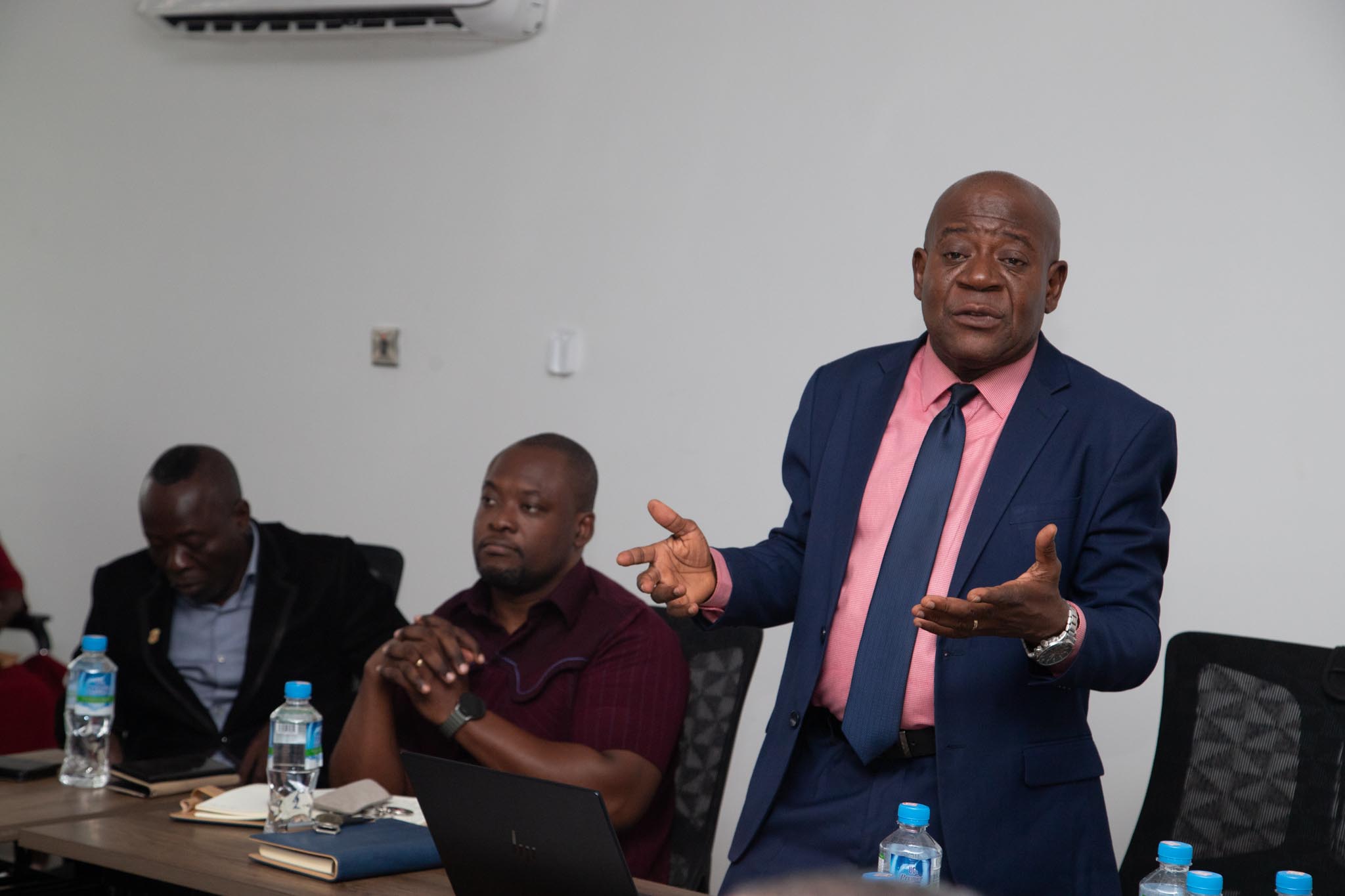
The Pro Vice-Chancellor for Research, Innovation and Development, Professor Samuel Nii Ardey Codjoe, has held his maiden Staff Durbar with staff of the Office of the Pro Vice-Chancellor and its affiliated directorates, outlining his vision for advancing research, innovation and institutional collaboration at the University of Ghana.
Held at the Research and Innovation Office Complex Boardroom on Wednesday, 5 August 2026, the Durbar provided an opportunity for Professor Codjoe to interact with staff, share his strategic priorities and discuss plans for strengthening research administration and fostering greater collaboration across the Office of the Pro Vice-Chancellor.
Welcoming participants, the Director of Research and Innovation, Professor David Dodoo-Arhin, described the occasion as an exciting moment for the Office and encouraged staff to offer the new Pro Vice-Chancellor their full support. He noted that RID had always regarded itself as one family and introduced the Directors of the various units under the Office of the Pro Vice-Chancellor, including the Director of the Institutional Research and Planning Directorate (IRPD), Professor John Effah; the Director of the Institute of Applied Science and Technology (IAST), Professor Samuel Kojo Kwofie; as well as the newly appointed Deputy Registrar for the Office of the Pro Vice-Chancellor, Mr. Emmanuel Baidoo.
Addressing staff, Professor Codjoe expressed his appreciation for the warm reception and remarked that he had looked forward to becoming Pro Vice-Chancellor for a long time. He acknowledged the significant progress made by his predecessors and pledged to build on the strong foundation they had established.
"It is my responsibility to build on what has already been done," he said. "I am here to share my vision, not to stop the excellent work that is already ongoing, but to add new ideas."
Professor Codjoe emphasised the importance of unity across the Office of the Pro Vice-Chancellor, stressing that the various directorates should work more closely together.
"For me, there is no RID or the other Directorates; there is just the Office of the Pro Vice-Chancellor."
To strengthen collaboration, he announced plans to institute regular staff engagements, establish an Executive Committee comprising heads of the various Directorates, and create additional committees to ensure broad staff participation in the implementation of the Office's strategic priorities.
Presenting his vision for research and innovation, Professor Codjoe highlighted his commitment to promoting impactful research by increasing external research funding and expanding the number of principal investigators (PIs) capable of attracting competitive grants, among other initiatives.
He observed that while government subvention remains the University's largest source of funding, research income has grown significantly and now exceeds revenue generated from student fees. He therefore underscored the need to strengthen research capacity as a sustainable source of institutional growth.
Among the key targets outlined for 2029 are increasing annual grant applications to 180, raising the proportion of principal investigators to 8% of faculty, and increasing research funding by 40%. While acknowledging that these targets are ambitious, Professor Codjoe expressed confidence that they are achievable through deliberate planning and collective effort.
To achieve these goals, Professor Codjoe proposed the establishment of multidisciplinary research groups to identify funding opportunities, develop competitive grant proposals, produce joint publications and mentor early-career researchers. The groups will receive institutional support to hold regular meetings and participate in grant-writing initiatives aimed at strengthening the University's research competitiveness. He also announced plans to institute an awards ceremony to recognise outstanding principal investigators and staff who contribute to the University's research enterprise.
He further announced plans to strengthen grant management through enhanced capacity-building programmes for Principal Investigators and Research Development Officers (RDOs), establish a committee to coordinate staff training, establish a College of Education Ethics Review Committee, and develop a clearer career trajectory for Research Development Officers.
The presentation also highlighted efforts to expand innovation and knowledge transfer, increase seed funding for the University of Ghana Research Fund (UGRF), promote multidisciplinary research to address national and global challenges, and strengthen systems that support research excellence across the University.
The interactive session afforded staff the opportunity to raise issues relating to research grant management, procurement processes, data collection from semi-autonomous units, and the administration of large institutional grants.
Responding to the concerns, Professor Codjoe assured staff that the issues would receive the necessary attention. He noted that he would explore mechanisms to improve procurement processes for research grants, facilitate access to institutional research data, and strengthen the University's capacity to coordinate large, multi-institutional research grants.
The Staff Durbar formed part of Professor Codjoe's efforts to engage staff, foster collaboration and chart a shared path towards achieving the University's research and innovation aspirations.