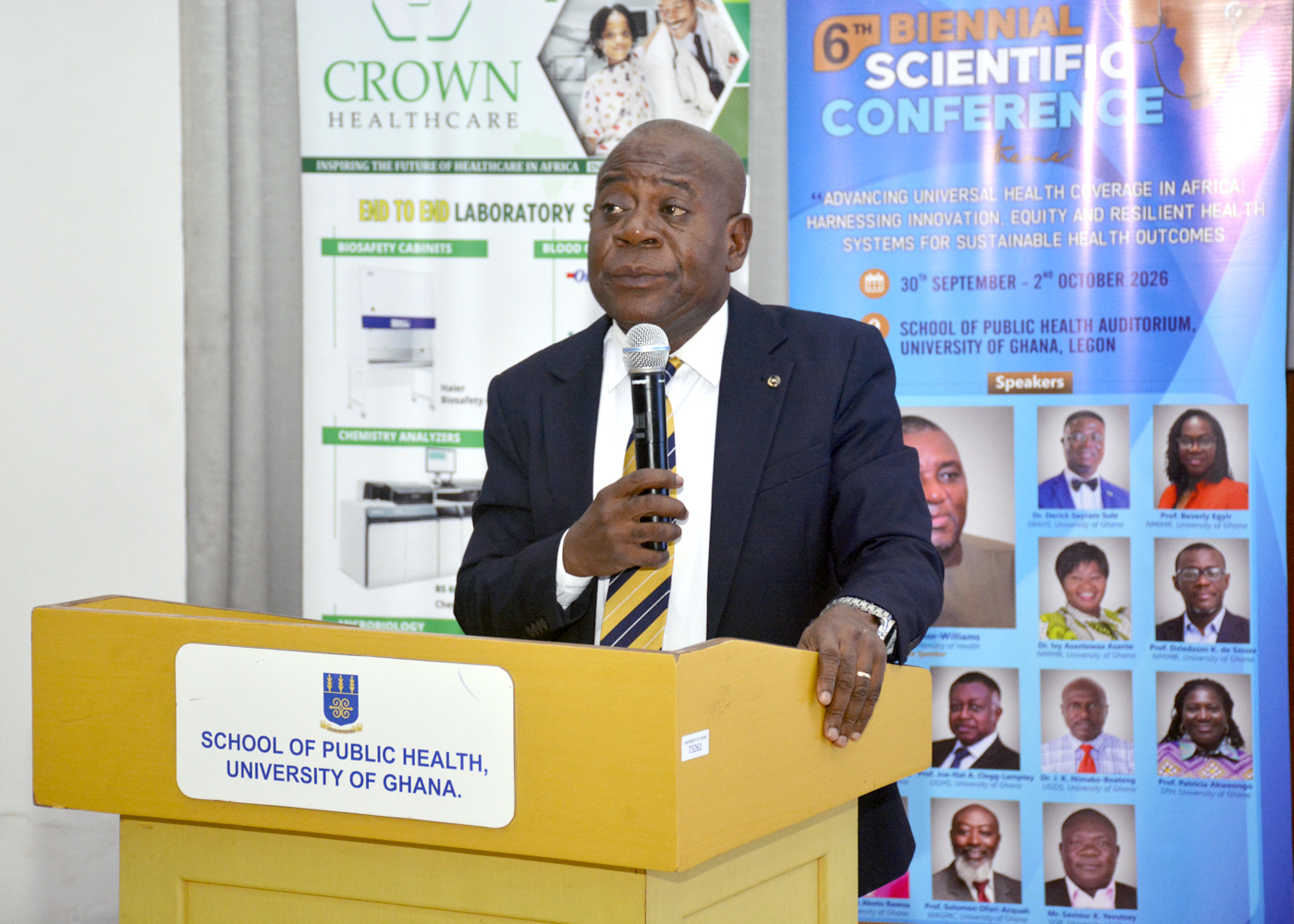
Professor Samuel Nii Ardey Codjoe, Pro Vice-Chancellor for Research, Innovation and Development (RID), has delivered the Chairperson’s address at the 6th Biennial Scientific Conference on the theme “Advancing Universal Health Coverage in Africa: Harnessing Innovation and Resilient Health Systems for Sustainable Health Outcomes”.
Speaking on behalf of the Vice-Chancellor, Professor Nana Aba Appiah Amfo, Professor Codjoe highlighted the need for research, policy and innovation to translate into better health outcomes and advance Universal Health Coverage (UHC) in Africa. He stated that the University’s vision for achieving UHC, seeks to ensure access to health services for everyone without suffering financial hardship.
He described UHC as a simple but profound commitment noting that the attainment of UHC in Africa requires more than expanding hospital infrastructure and increasing the number of health professionals. It also demands research-informed policies, effective implementation and sustained efforts to address barriers to healthcare access.
Professor Codjoe situated the University’s vision within the World Health Organization’s 14th General Programme of Work (2025–2028) and Sustainable Development Goal (SDG) target 3.8 on UHC. He noted that these priorities align with the University’s Strategic Plan 2024–2029, which focuses on impactful research, transformative student experience, engagement and partnerships, commitment to faculty and staff, and sustainable resource mobilisation and stewardship.
On the role of technology in healthcare, he explained that the introduction of a new panel on artificial intelligence (AI) and data systems at the conference was a deliberate step towards addressing emerging opportunities and challenges in health research and service delivery. However, he cautioned that technology alone cannot deliver UHC. Issues such as access, interoperability, data privacy, cybersecurity, regulation, accountability and digital literacy must also be addressed to ensure that technological advances do not leave underserved populations behind.
He further emphasised the importance of bridging the gap between research and practice, stressing that research findings must inform policy, policies must translate into implementation, and implementation must ultimately lead to better health outcomes. He noted that the impact of a university should be measured not only by its publication output but also by the extent to which its scholarship transforms society.
Addressing students, Professor Codjoe encouraged them to approach the conference as a lecture, using the opportunity to learn from experienced researchers, exchange ideas and build professional relationships. He expressed hope that collaborations initiated at the conference will be sustained into the future.
Responding to an earlier plenary discussion on climate change, he offered to fund a student to undertake flood simulations for health facilities across the country, including Community-based Health Planning and Services (CHPS) compounds. The proposed exercise would use geographic information systems (GIS) to identify facilities exposed to flood risks and support better planning to protect healthcare access during flooding.
His remarks reinforce the importance of connecting research, innovation and collaboration with practical solutions to Africa’s healthcare challenges, while underscoring the University of Ghana’s commitment to research that makes a meaningful difference in society.