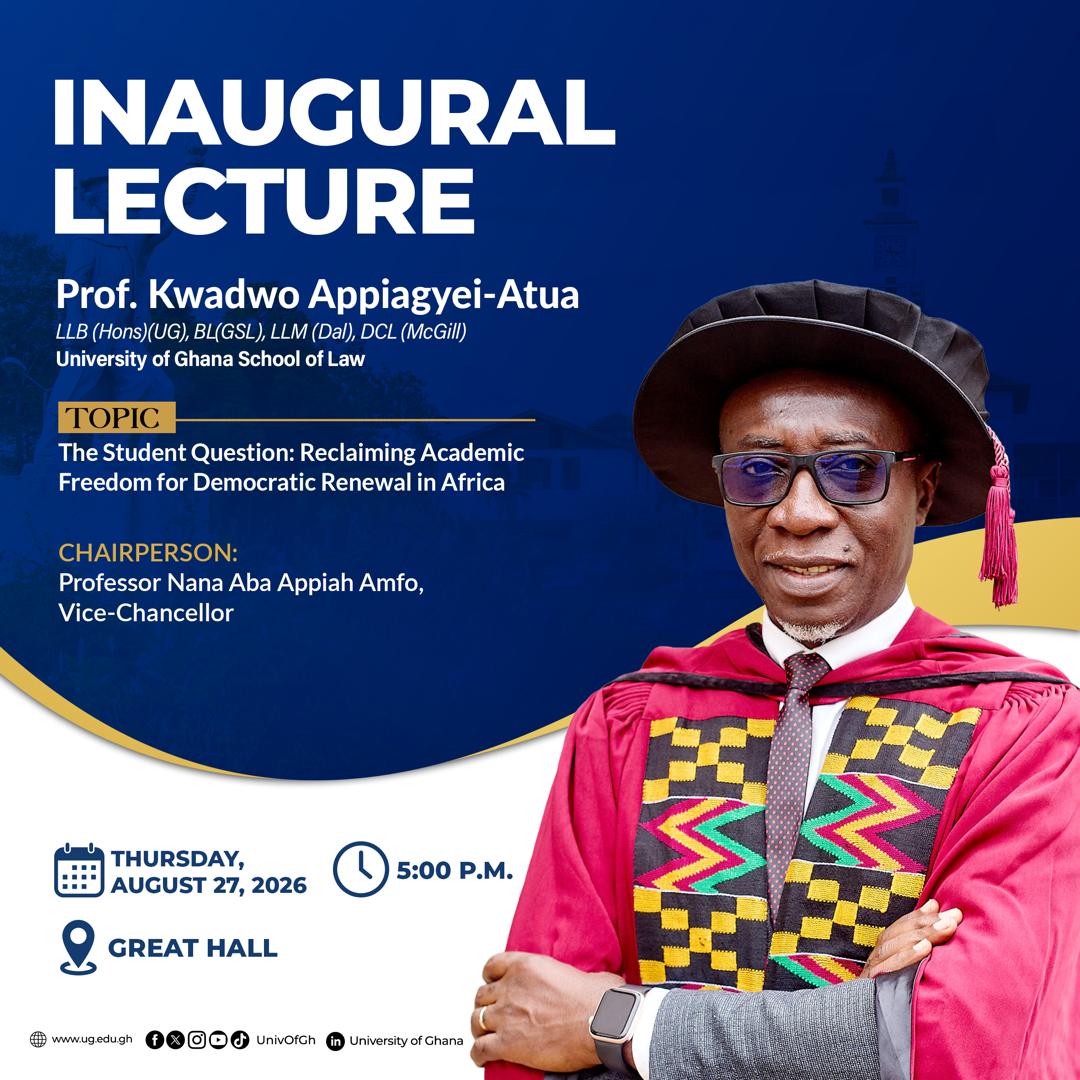
Profile
Professor Kwadwo Appiagyei-Atua is a Professor of International Law and Human Rights at the University of Ghana School of Law and an adjunct professor at institutions in South Africa, The Gambia and Ireland. He holds an LLB from the University of Ghana, a professional law degree from the Ghana School of Law, an LLM from Dalhousie University and a DCL from McGill University, both in Canada.
He began his academic career internationally before returning to Ghana in 2005, when he joined the University of Ghana as a Senior Lecturer. His work extends beyond academia into civil society, legal advocacy and international consultancy, including engagements with the African Union, ECOWAS and the United Nations. He has also served on several international boards and academic freedom organisations.
A major area of his scholarship and activism is academic freedom in Africa. His work in this field began after representing the University of Ghana at an academic freedom workshop in Ethiopia and eventually led to his becoming founding Regional Director of the Africa Coalition for Academic Freedom. His research examines the need to decolonise and democratise academic freedom, universities, curricula and pedagogy in Africa.
His broader scholarship focuses on human rights, development, African legal philosophy, decolonisation and Third World Approaches to International Law (TWAIL). From his doctoral research, he developed the theory of community emancipation, an interdisciplinary framework drawing on Akan understandings of rights and linking African philosophy with African approaches to human rights.
Professor Appiagyei-Atua's interdisciplinary research also challenges conventional accounts of the origins of higher education, highlighting historical African centres of learning such as the per-ankh in Egypt, Al-Azhar, Al Quaraouine, Sankore and Ethiopian institutions.
He is also an active public intellectual and scholar-activist, engaging national issues including corruption, illegal mining, governance and human rights through the media and public advocacy. His legal activism includes leading a successful Supreme Court challenge in Appiagyei-Atua & 7 Others v Attorney-General concerning the constitutionality of Ghana's Imposition of Restrictions Act, 2020 (Act 1012) and its implications for fundamental rights.
ABSTRACT:
The Student Question: Reclaiming Academic Freedom for Democratic Renewal in Africa
The raison d'être of the university, traced from Africa’s pre-modern higher education systems, is two-fold: first, to create a congenial atmosphere for learning as well as the pursuit, production, dissemination and protection of knowledge. The second is to advance social justice through the application of knowledge as a public good, speaking truth to power and challenging orthodoxy. To enable the performance of these duties, the university is accorded a specialised right – academic freedom, which, is linked to democracy – both within universities and in broader society – and shaped by the international laws and concepts of rights that existed in Africa before European contact.
European later contact with Africa’s higher education systems moved from collaboration to confrontation, resulting in epistemicide, linguicide and theft of history. Since then, Africa’s higher education system has continued to struggle to recapture its raison d’etre. Thus, whilst globally there is a general assault on the university and its academic freedom, the situation in Africa has become more precarious in the face of democratic backsliding and shrinking civic and political spaces. The conventional narrative identifies extra-mural factors and actors as generally responsible for the violations, with the State as the principal culprit against the university as a collective. However, by externalising the issue, little attention has been paid to the intra-mural.
The thesis of this lecture is that disaggregating "the University" into competing interests (classes) rather than treating it as a unified victim exposes the academic community as co-violators of academic freedom in their relationship with each other. Doing so helps to affirm the importance of identifying other factors that impact on the realisation of the pro-democracy/social justice mandate of the university. It also helps to assess how responding to and addressing those factors have the potential to reinvent democracy internally and have a spill-over effect in the larger society.
Findings indicate that the African university has become a site of repression by university administration (referred to as the "ruling class," making up 2-5% of the university population and often set up as proxies for the State) against academics and students, with the latter being the more oppressed. Students (the "lower class," constituting at least 80% of the university population) also face oppression at the hands of academics ("middle class"/"organic intellectuals," 5-8%) who exploit the asymmetrical power relations in the classroom to consolidate and perpetuate power.
The marginalisation of students from the academic freedom equation finds expression in the "banking model" of education, where teachers only deposit knowledge into passive students. This approach discourages critical thinking among students and disables them from being aware of their own oppression. The approach helps to maintain existing social hierarchies and numb legitimate resistance by students. This has become possible largely due to massification in higher education in many African universities.
Other factors affecting students' academic freedom are the infiltration and co-optation of student leadership by political parties through the setting up of party structures on campuses to influence student politics, sometimes through orchestration and legitimation of the use of violence and manipulation during elections. The end-result has been disenfranchisement of the general student population and their dissatisfaction and distrust in student leadership, though they generally have an enlightened understanding of, and craving for, democracy and interest in university governance.
As a result, students prefer to choose the path of "least resistance" ("culture of silence") in their relations with university administration and academics or engage in violent confrontations as a last resort. In this regard, students' least resistance versus violence choice mirrors youths' democratic commitment versus tolerance for military intervention based on an Afrobarometer 2021-23 and African Youth Survey 2026 report regarding the perception of the youth in national politics. They express interest in democracy but disillusionment with democratic dividends produced by the political elite. Consequently, they are more likely to accept military takeovers when elected leaders abuse power for their own ends. Some are also asking for new models of democracy rooted in Africa’s reality. Both suggest discontent with process legitimacy rather than rejection of democratic values.
The lecture argues that academic freedom issues are rarely solved through a command-and-control approach that sidelines critical governance stakeholders in the university space – especially students who possess democratic legitimacy as primary beneficiaries of the university – and those outside it, including civil society organizations and professional associations which provide advocacy and monitoring capacities. Instead, a collaborative governance model, which relies on negotiations, cooperation and interactions among key interdependent actors possessing different resources, forms of legitimacy, and capacities, is recommended.
Relevant identified actors will be assigned a series of “democratisation tasks”, which involves a differently conceived democratic order. One, to democratise student politics and control political party influence on university campuses. This may include progressive or intellectuals within the university and civil society actors solidarising and collaborating with students to challenge the legitimacy of the dominant order and restore civic participation in student governance.
Two, democratisation of the classroom, among others, through collaboration between student and academic unions to recalibrate the asymmetrical power relations between academics and students to democratise pedagogy and curriculum. This endeavour will involve adopting the "pedagogy of the oppressed" model of education, which will add to the traditional "epistemological task" of academics, the "political task" of developing the student's political consciousness to produce in them "extra-functional abilities." Student-academic union collaborations should then provide avenue for them to challenge the managerialist character and undemocratic practices of university administration to create a de-hierarchised social order within the university.
This model will add to the discussion on "who is violating academic freedom" the discourse on "how multiple actors can jointly construct institutions that protect academic freedom to enable the university to realise its raison d'être."
However, the #FeesMustFall movement in South Africa shall be used as case-study to show that where the collaborative governance model proves ineffective, students have the legitimate right to resort to disruption, occupation and confrontation within the law to achieve their goals. In this respect, student (and larger Gen Z protests) that led to the overthrow of governments or caused governments to succumb to their demands in Madagascar, India, Bangladesh and others will be referenced.
The democratisation project will result in a conscientised and liberated student force and their restoration from the periphery to the core of the academic freedom structure. Consequently, students will acquire a voice to articulate their concerns and grievances for redress and not resort to violence to achieve their targets. Further, students will be equipped to join gown to town – collaborate with youth in larger society to apply alternative dividend-yielding models of democracy rooted in Africa’s history and reality.
The lecture concludes that the future of Africa's democracy lies in how democracy is practised in the classroom and on the larger campus in Africa's universities and the critical role that students' academic freedom can play in democracy in the larger society. In other words, the lecture proposes a return to the past to deconstruct and retrieve meaning from what colonialism, international law and the liberal script sought to obliterate in our understandings of the university, its raison d’être, academic freedom and democracy and to reconstruct same for the greater good of the continent.