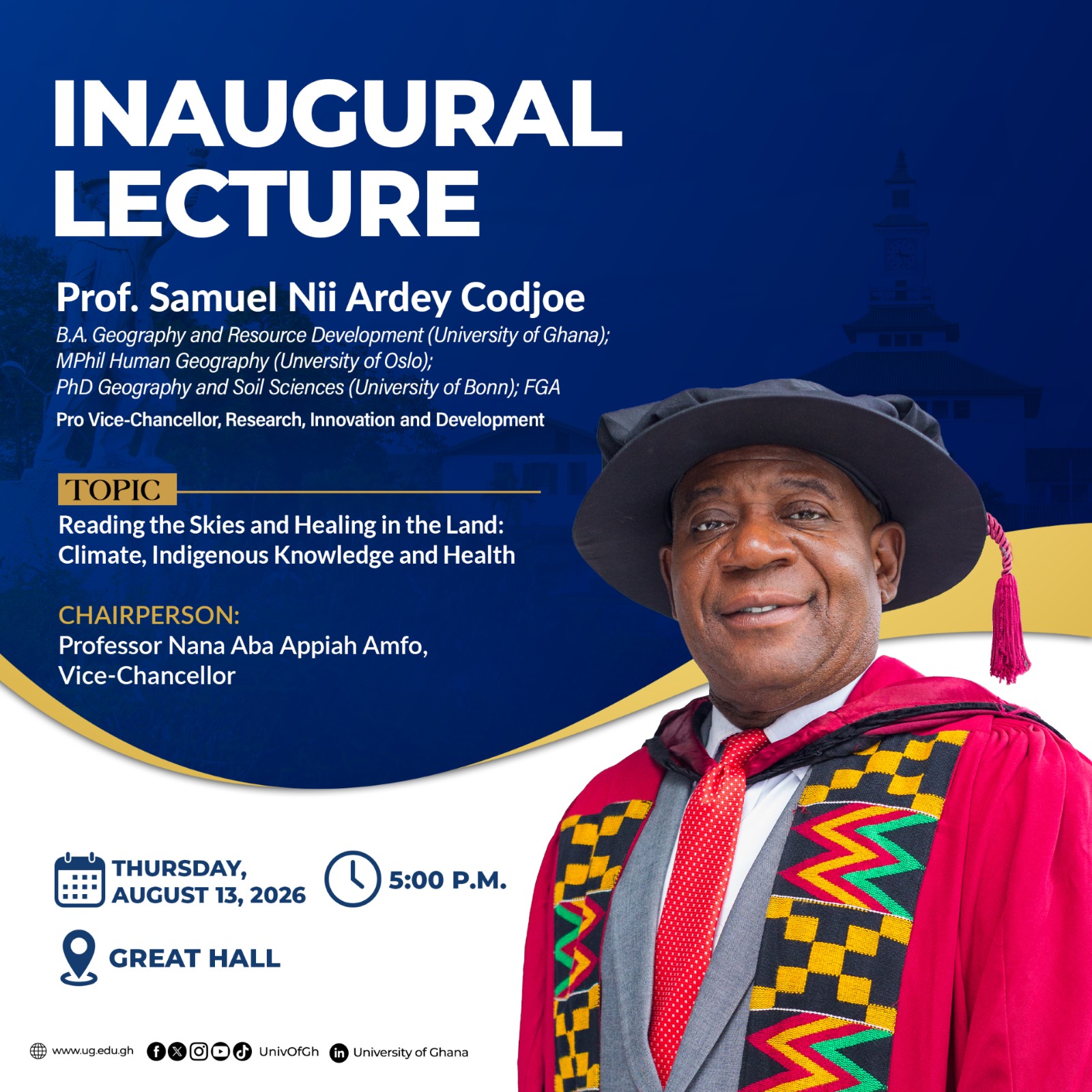
Profile
Professor Samuel Nii Ardey Codjoe is a Professor of Population Studies at the Regional Institute for Population Studies (RIPS), University of Ghana, and currently serves as Pro Vice-Chancellor for Research, Innovation and Development. He is also a Fellow of the Ghana Academy of Arts and Sciences and has held several senior academic and leadership positions at UG and internationally.
He joined the University of Ghana in 2004 and became a Full Professor in 2015. As Director of RIPS, he strengthened research capacity, international partnerships, postgraduate training and student support, including the establishment of quality assurance structures, an endowment fund for doctoral training and improved facilities for PhD students.
Professor Codjoe is a leading researcher in climate change, population dynamics, migration, health, food security and sustainable development. He has led or contributed to 25 major research projects that attracted nearly US$40 million in funding to the University of Ghana. He has also mentored numerous researchers and postgraduate students and established platforms for research collaboration and intellectual exchange.
As Provost of the College of Education, he led significant growth in research, faculty development, student support and infrastructure. During his tenure, externally funded research grants increased substantially, the number of professors grew from three to eighteen, and initiatives such as the College of Education Scholarship Programme, Digital Youth Village, and Kumasi and Takoradi City Campuses were established or advanced.
Beyond the University, Professor Codjoe has contributed extensively to national, continental and international initiatives in climate change, population studies and sustainable development. His work has earned numerous honours and awards, reflecting his contributions to scholarship, research, leadership, mentorship and institutional transformation.
Abstract
Reading the Skies and Healing in the Land: Climate, Indigenous Knowledge and Health
Climate change is a major environmental and health challenge affecting livelihoods, food security, and wellbeing. This lecture, Reading the Skies and Healing in the Land: Climate, Indigenous Knowledge and Health, examines links between climate change, indigenous knowledge, disease patterns, and healthcare in Ghana. It argues that effective adaptation requires integrating scientific evidence with local knowledge to strengthen climate monitoring, disease prevention, and resilient health systems.
A central theme of the lecture is the importance of indigenous knowledge systems in climate monitoring and adaptation. Indigenous knowledge represents place-based observations, practices and understandings developed over generations through continuous interaction with the natural environment. When communities “read the skies”, they draw on a rich body of indigenous environmental knowledge, turning clouds into calendars, to anticipate seasonal changes, protect livelihoods and safeguard their health. Furthermore, communities often “read the skies” by observing environmental indicators such as cloud formations, moon phases, frog sounds, bird movements, ant behaviour, sea conditions, and fish harvests to predict rainfall and seasonal changes. Such knowledge remains invaluable because it is locally grounded, culturally relevant, livelihood embedded, and accessible to community members. This lecture demonstrates that in settings where scientific meteorological information is limited, indigenous forecasting systems continue to play an important role in environmental monitoring and decision-making.
In Ghana, climate change is often understood through observable changes in weather, rainfall, and temperature. Indigenous expressions in Akan, Ga, and Ewe reflect local interpretations of environmental change. Communities commonly attribute climatic shifts to deforestation, bush burning, charcoal production, pollution, sand winning, and the decline of traditional environmental practices. Some also view climate change through spiritual lenses. While these explanations highlight important local environmental concerns, they often overlook the historical contribution of industrial emissions from developed countries, potentially leading communities to assume responsibility for changes largely driven by global processes.
In the view of communities, climate change produces both benefits and challenges for populations and livelihoods. Increased rainfall can support agriculture, fisheries, irrigation, domestic water supply, and hydropower generation. High temperatures may enhance solar energy production, salt extraction, and crop/fish drying. However, excessive rainfall frequently leads to flooding, soil erosion, destruction of farms and property, human displacement, and outbreaks of diseases such as cholera, typhoid, and malaria. Extreme heat contributes to droughts, bushfires, reduced fish catches, water shortages, and heat-related illnesses. These impacts are increasingly evident in recurrent floods, droughts, and tidal waves affecting vulnerable communities, particularly in coastal areas such as Accra, Ada and Keta.
The lecture also examines the lived experiences of climate change, particularly extreme heat and flooding. Research conducted in Accra and Tamale found that indoor temperatures in homes, workplaces, and public institutions can be significantly higher (10°C) than those recorded by meteorological stations. Some indoor environments exceeded 48°C, while temperature in a blacksmith workshop reached over 60°C. These findings suggest that conventional weather measurements may underestimate actual human exposure to heat. Excessive temperatures affect health, sleep quality, productivity, and agricultural activities while also contributing to biodiversity loss. Suggested adaptation measures include improved building ventilation, tree planting, ceiling insulation, alternative roofing materials, and climate-responsive architectural designs.
Flooding remains one of the most serious climate-related hazards in urban Ghana. Low coastal elevations, inadequate drainage infrastructure, unplanned settlements, and poor waste management combine to increase flood risks. Research in Accra revealed a pattern of mistrust among stakeholders, with communities, government agencies, and private actors often blaming one another for flooding events. The lecture argues that more effective flood management requires collaboration among local authorities, traditional leaders, community organizations, and formal government institutions. Integrating local institutions into planning processes can strengthen cooperation and improve adaptation outcomes.
The relationship between climate change and disease is another major focus. The lecture discusses schistosomiasis, a waterborne parasitic disease that became more widespread following the construction of the Akosombo Dam. The dam created favourable conditions for the proliferation of host snails that transmit the disease. Community members associated rising temperatures and changing rainfall patterns with increased exposure, particularly through contact with rivers and ponds. These findings highlight the importance of complementing biomedical interventions with local knowledge and expanding prevention programmes to vulnerable populations.
The lecture also examines cerebrospinal meningitis (CSM) in northern Ghana. Communities identify factors such as rising temperatures, drought, dust, dehydration, overcrowding, and poor ventilation as contributors to disease transmission. In response, they adopt a range of adaptation measures, including mass vaccination campaigns, improved housing design, cleaner cooking technologies, sleeping in well-ventilated spaces, afforestation initiatives, and the protection of sacred groves. These examples demonstrate how communities blend traditional practices and modern interventions to address climate-related health threats.
Climate change also poses growing challenges for healthcare systems. Hospitals in cities such as Accra and Tamale increasingly face extreme heat, flooding, water shortages, and power disruptions. High indoor temperatures affect healthcare workers, reduce patient comfort, and threaten the safe storage of medicines and vaccines. Flooding can damage infrastructure, interrupt access to healthcare services, and increase patient numbers during disease outbreaks. To strengthen resilience, the lecture recommends climate-sensitive hospital design, improved ventilation, enhanced drainage systems, elevated infrastructure, renewable energy technologies, contingency plans for power outages, and early warning systems for floods and heatwaves.
Overall, the lecture demonstrates that climate change is not merely an environmental issue but also a health challenge with social, cultural and economic dimensions. Indigenous knowledge offers valuable insights into climate observation, adaptation, and resilience, while community perceptions shape responses to climate-related risks. Integrating scientific knowledge with local understandings provides a comprehensive approach to strengthening health systems, improving adaptation strategies, and building resilient communities in Ghana and across Africa.