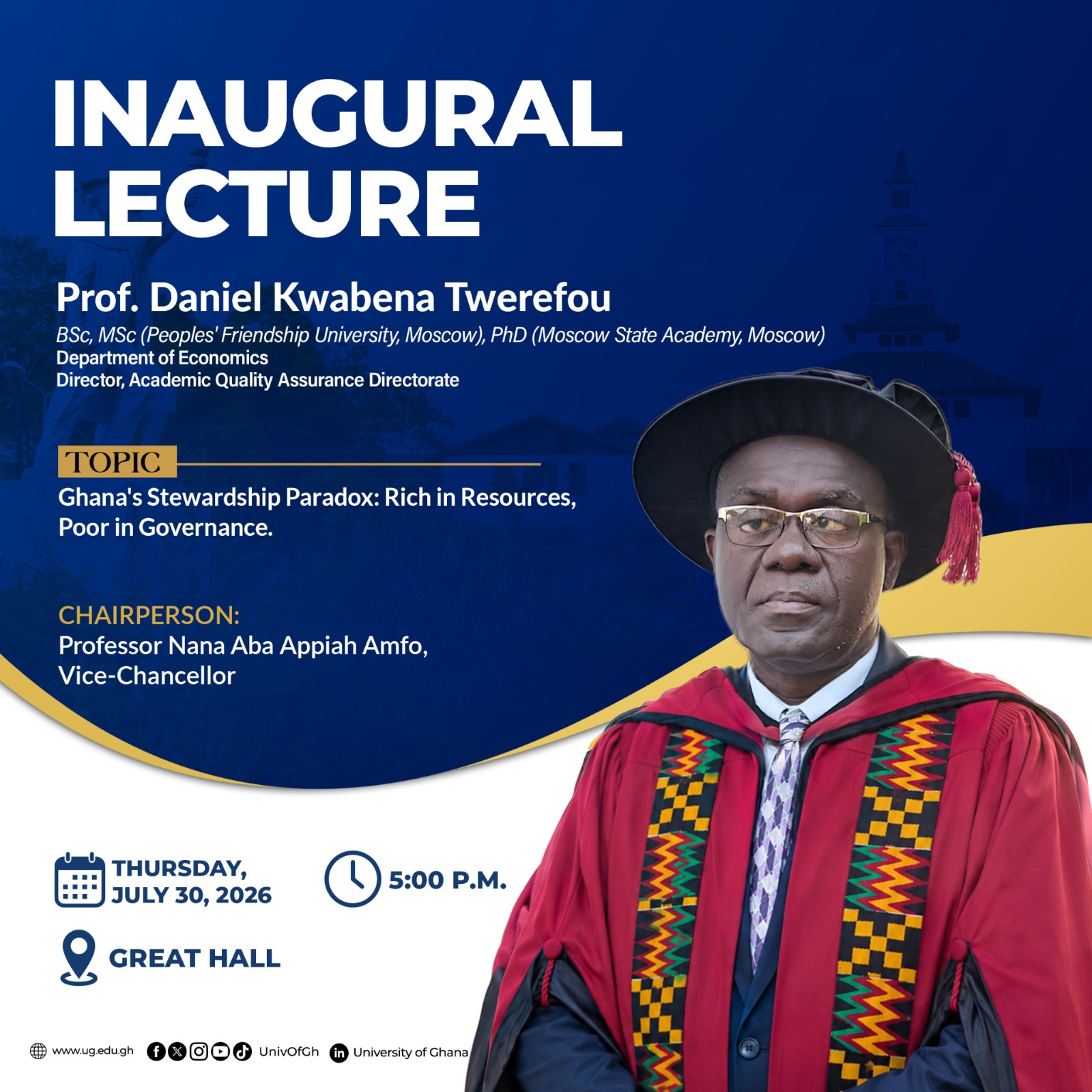
Profile
Professor Daniel Kwabena Twerefou is a distinguished economist and academic with over two and a half decades of experience in teaching, research, policy engagement and institutional leadership. He is a Professor in the Department of Economics at the University of Ghana, with expertise in environmental and natural resource economics, climate change, energy economics and sustainable development. His work combines academic research with practical policy applications aimed at addressing development challenges in Ghana and Africa.
He joined the University of Ghana in 2000 as a Lecturer and rose through the academic ranks to become a Professor in November 2024. Since 2020, he has served as Director of the Academic Quality Assurance Directorate (AQAD), where he has led initiatives to strengthen quality assurance, promote innovative teaching and improve academic standards. His achievements include the digitisation of the Course and Lecturer Evaluation system, integration of artificial intelligence into higher education, and development of self-paced pedagogical training modules.
Professor Twerefou has also made significant contributions to teaching and mentoring. He has taught undergraduate and postgraduate courses in economics, environmental economics, climate change, applied mathematics and statistics, among others. His teaching incorporates real-world datasets, policy documents and empirical methods to develop students’ evidence-based decision-making skills. He has supervised 20 PhD students, over 100 postgraduate students and 30 undergraduate students.
His research focuses on climate change, energy economics, environmental policy, natural resource management and sustainable development. He has authored over 60 academic publications and approximately 70 technical reports, with his research attracting competitive funding and contributing to policy discussions on environmental and development issues.
Beyond academia, Professor Twerefou has extensive consulting and public service experience. He has worked with organisations including the World Bank, UNDP, African Development Bank, UNECA, IMF, Ghana’s Environmental Protection Agency and the National Development Planning Commission. He has contributed to major national initiatives, including Ghana’s Nationally Determined Contributions, Low-Carbon Development Strategy and Natural Capital Accounting Framework.
He maintains an active international professional profile through conferences, research networks, professional associations, editorial responsibilities and capacity-building programmes across Africa and beyond. His career reflects a sustained commitment to academic excellence, quality higher education, environmental sustainability, research, policy development and the training of the next generation of scholars and professionals.
Abstract
Ghana is richly endowed with forests, rivers, fertile lands, fisheries, minerals, biodiversity and other natural resources that have supported livelihoods, economic growth and national development for centuries. These resources constitute a vital form of wealth that underpins production, employment, food security, public health and overall human well-being. Yet despite this abundance, many of Ghana’s ecosystems are experiencing increasing degradation. Forests continue to disappear, fish stocks are declining, water bodies are becoming polluted, biodiversity is being lost and environmental deterioration is imposing growing economic and social costs. This reality raises a fundamental question: how can a country so richly endowed with natural resources struggle to sustain the very assets upon which its development depends?
This lecture examines what I describe as Ghana’s Stewardship Paradox: the coexistence of abundant natural wealth with persistent weaknesses in environmental stewardship. The paradox is particularly striking because environmental management in many pre-colonial and colonial communities was often embedded within social norms, customary institutions, cultural values and traditional systems of accountability. Sacred groves, protected rivers, seasonal restrictions, taboos and community-based governance mechanisms helped regulate resource use and ensured that economic activities remained broadly within ecological limits. While these systems were not perfect, they reflected an understanding that human welfare depended on maintaining the productive capacity of nature.
Since independence, Ghana has pursued industrialisation, agricultural expansion, urbanisation, infrastructure development, mineral extraction and energy production as pathways to economic transformation. These efforts have generated important development gains and contributed significantly to national income and modernisation. However, they have also intensified pressure on forests, fisheries, land, water resources and biodiversity. In many cases, economic growth has occurred without adequately accounting for the environmental costs associated with resource depletion, pollution and ecosystem degradation. As a result, some forms of economic progress have been accompanied by the erosion of the natural foundations upon which long-term prosperity depends.
Drawing on insights from natural resource economics, the lecture examines the management of both renewable and non-renewable resources. Renewable resources such as forests, fisheries and agricultural land generate benefits only when extraction remains within regenerative limits. Yet evidence suggests that deforestation, land degradation and overfishing have increasingly undermined the capacity of these resources to sustain livelihoods and future production. Similarly, the exploitation of non-renewable resources, including gold, oil, gas and emerging critical minerals, has generated substantial revenues but has often been associated with environmental degradation, weak domestic linkages and limited transformation of resource wealth into long-term productive assets. These experiences raise important questions about how resource rents are managed and whether current patterns of extraction are creating lasting prosperity or simply accelerating resource depletion.
From the perspective of environmental economics, the lecture highlights how many environmental costs remain externalised. Activities that generate private benefits frequently impose costs on society through pollution, ecosystem destruction, health impacts and declining environmental quality. Rapid urbanisation has increased waste generation, while industrial emissions, vehicle exhaust, household energy use and illegal mining have contributed to growing air, water and land pollution. These environmental burdens affect not only ecosystems but also households, businesses and public institutions that bear the costs of environmental damage. The result is a growing gap between private gains and social costs, leading to outcomes that are economically inefficient and environmentally unsustainable.
The lecture further explores these challenges through the lens of welfare economics. Environmental degradation reduces welfare not only through the loss of environmental amenities but also through its effects on health, productivity, income and quality of life. Polluted water bodies increase treatment costs and health risks. Air pollution contributes to disease and premature mortality. Declining fisheries and degraded agricultural lands threaten livelihoods and food security. Biodiversity loss reduces ecosystem resilience and limits future opportunities for economic and social development. In this sense, environmental decline represents more than an ecological problem; it is fundamentally a welfare challenge that affects current and future generations.
The lecture also draws on institutional economics to explain why environmental degradation persists despite the expansion of environmental laws, regulatory agencies and policy frameworks. Ghana today possesses far more formal environmental institutions than existed in the past. Yet institutional effectiveness depends not merely on the existence of rules but also on enforcement capacity, accountability, incentives, coordination and public trust. Weak enforcement, overlapping mandates, inadequate resources and short-term political and economic pressures often undermine environmental governance. The result is a transition from stewardship embedded in social institutions to environmental management that is increasingly bureaucratic but not always effective.
Ultimately, this lecture argues that sustainable development requires a renewed commitment to stewardship. Natural resources should be viewed not simply as commodities to be extracted but as productive assets that generate long-term economic and social value. Effective stewardship requires recognising the full value of ecosystems, strengthening institutions, improving accountability, internalising environmental costs and ensuring that resource use today does not diminish opportunities for future generations. Ghana possesses the knowledge, policy space and institutional foundations needed to pursue this transformation. The central message of this lecture is therefore simple but profound: the true measure of development is not how rapidly a nation converts natural resources into economic growth, but how effectively it manages those resources to sustain prosperity, welfare and environmental integrity across generations.